[Held on 2025/1/15 at 10:00] ALIGN Webinar #12 Jesse Hoogland : Singular Learning Theory for AI Safety
Singular Learning Theory: The Key to Deciphering the Internal Structure of Deep Learning
The internal structure of AI, particularly deep learning, has often been called a “black box.” However, Singular Learning Theory (SLT) is a powerful tool that mathematically unpacks the contents of this black box and reveals its “secrets.” Here, we explore how this theory (SLT) explains the essence of deep learning.
1. Model “Singularity” and the Geometry of the Loss Landscape
The core of SLT lies in focusing on the structure of the loss landscape—the shape of the loss function in the model’s parameter space. In the case of classical regular models (such as linear regression), the loss landscape is simple, and there exists a unique optimal solution (global optimum). On the other hand, in singular models such as neural networks, the loss function has a complex structure, characterized by multiple optimal solutions (local and global optima) forming a set of singular points, as explained later.
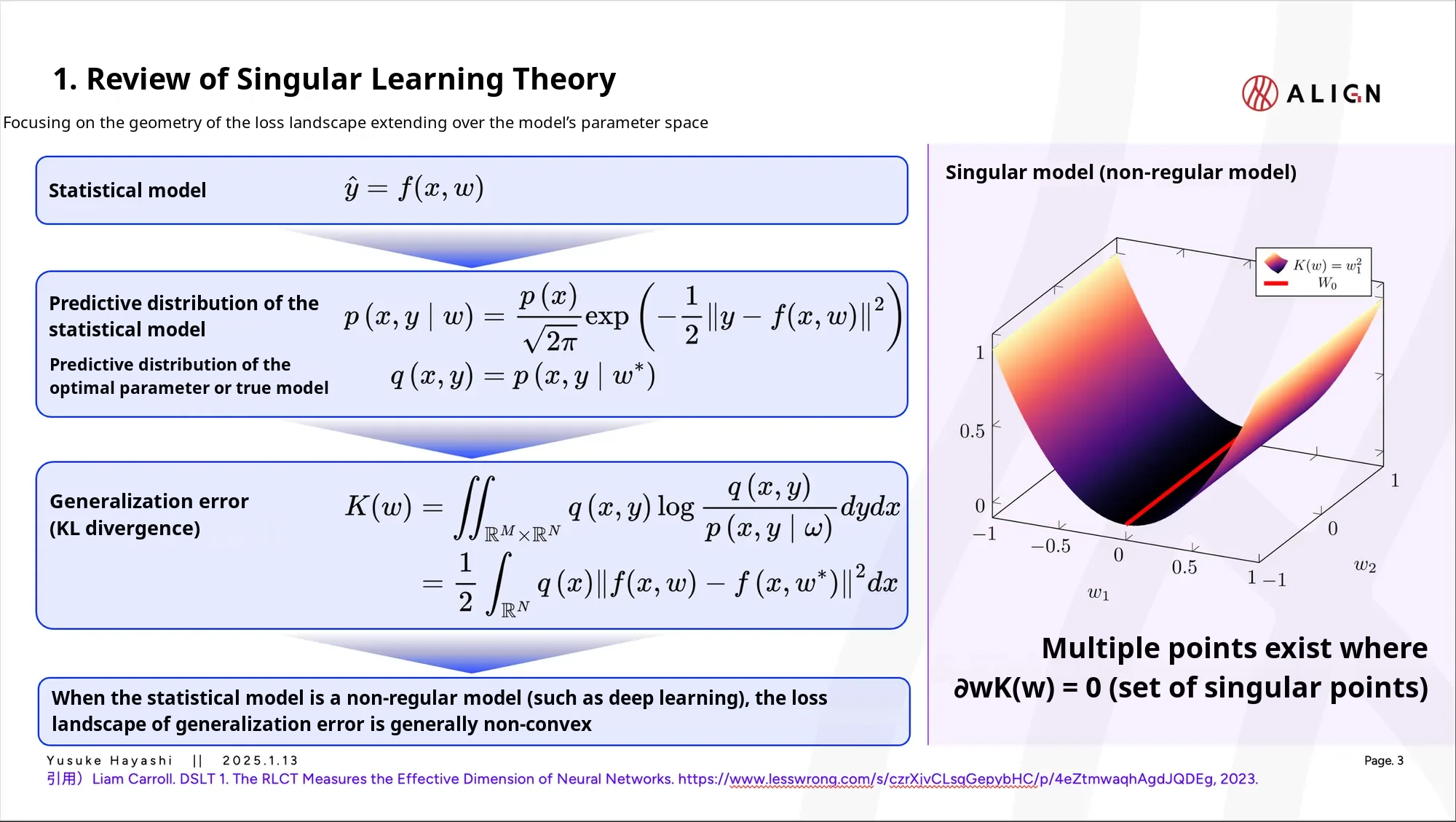
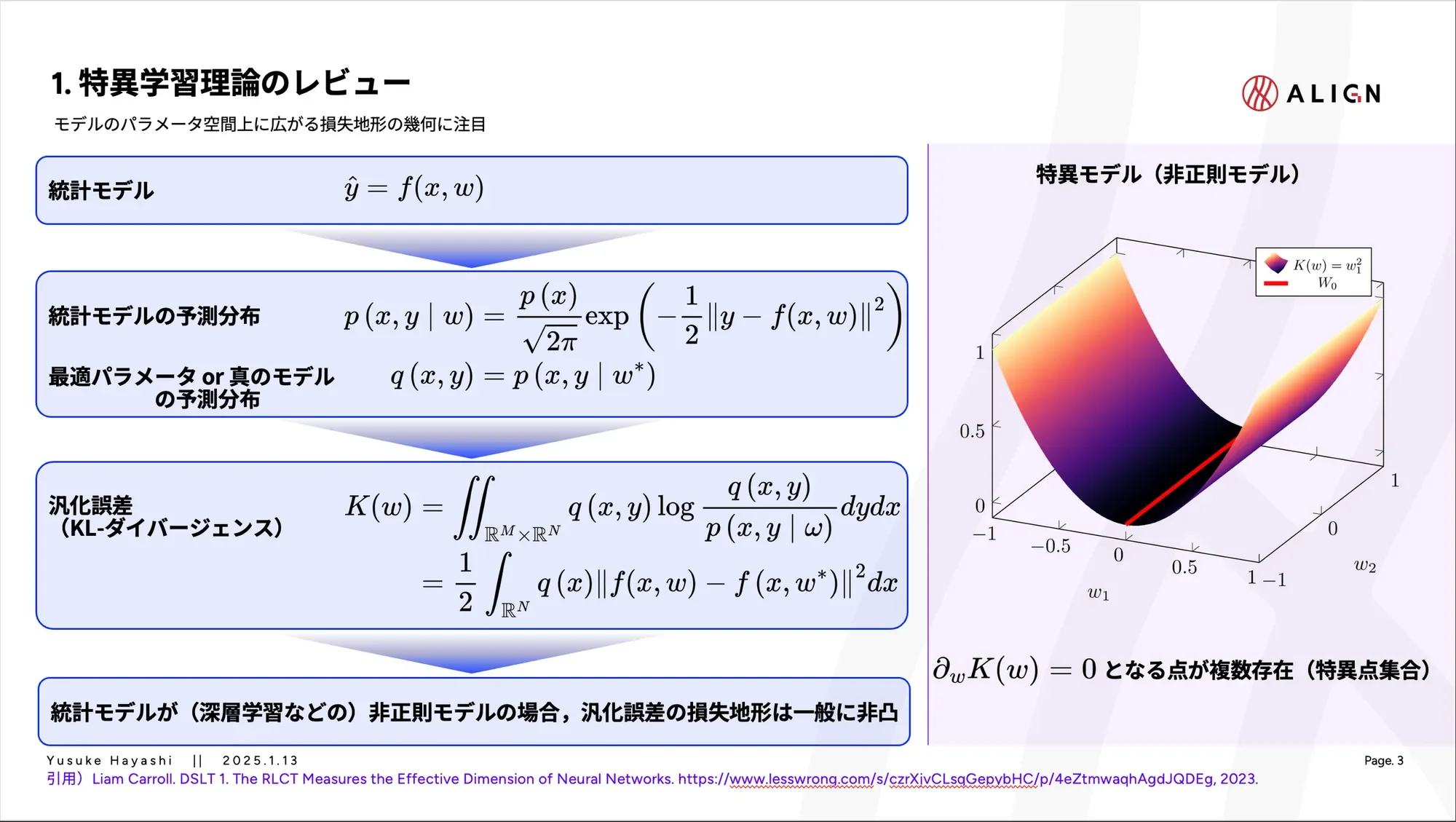
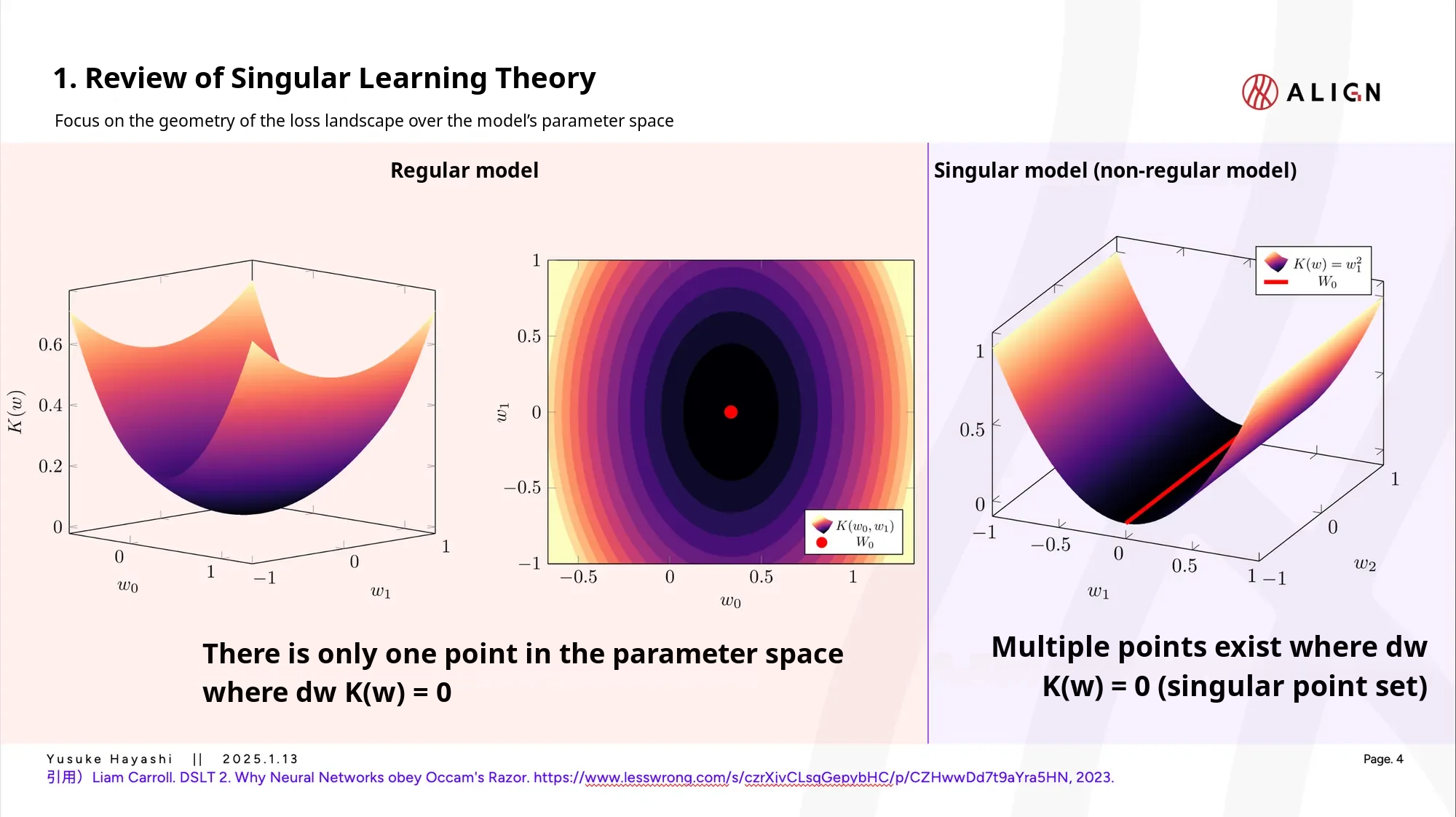
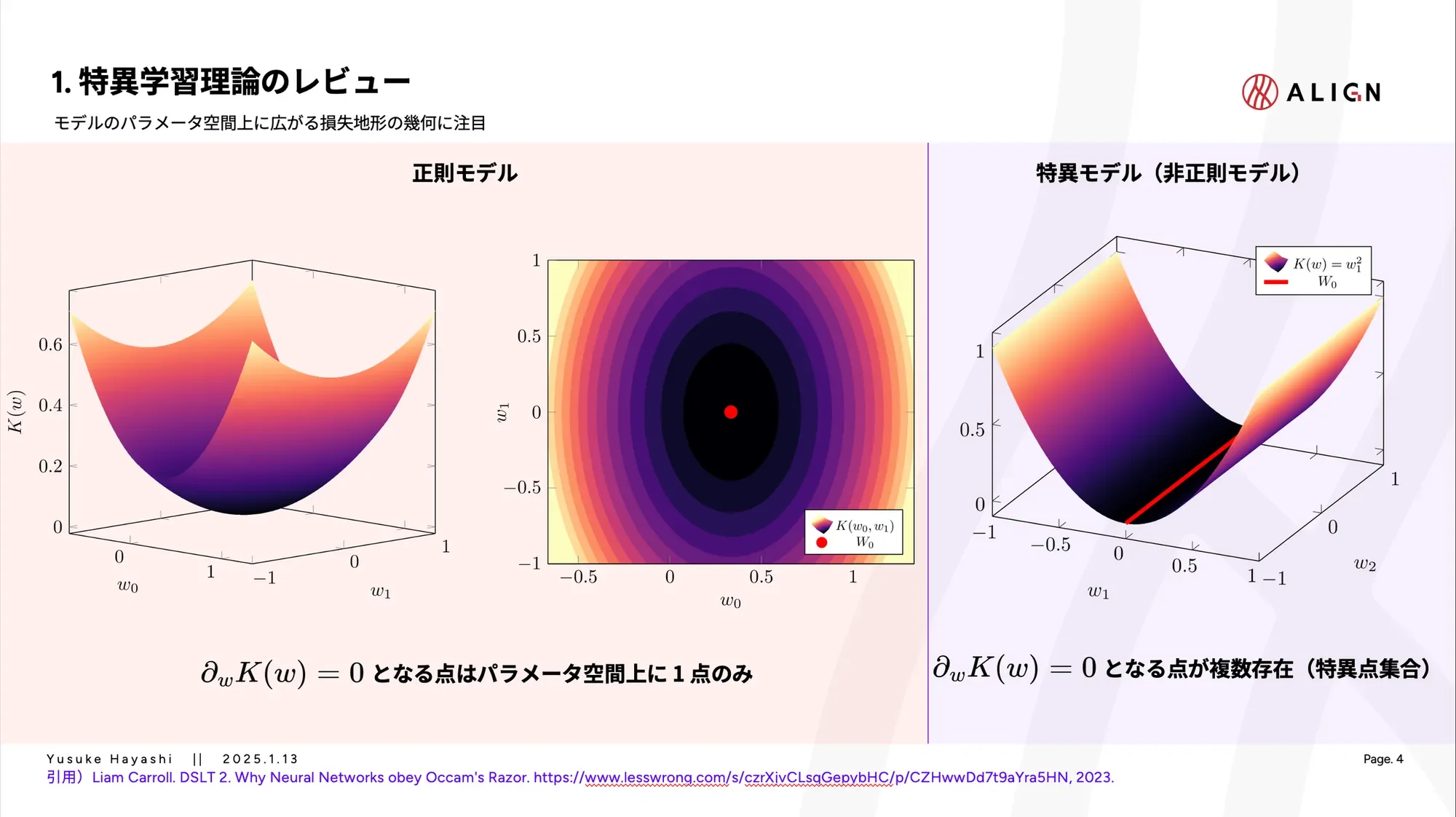
The loss landscape directly affects the model’s learning process. For example, in the vicinity of singular points in the parameter space, the Fisher information matrix degenerates, exhibiting special behavior not observed in regular models. Expressing this in mathematical formulas:
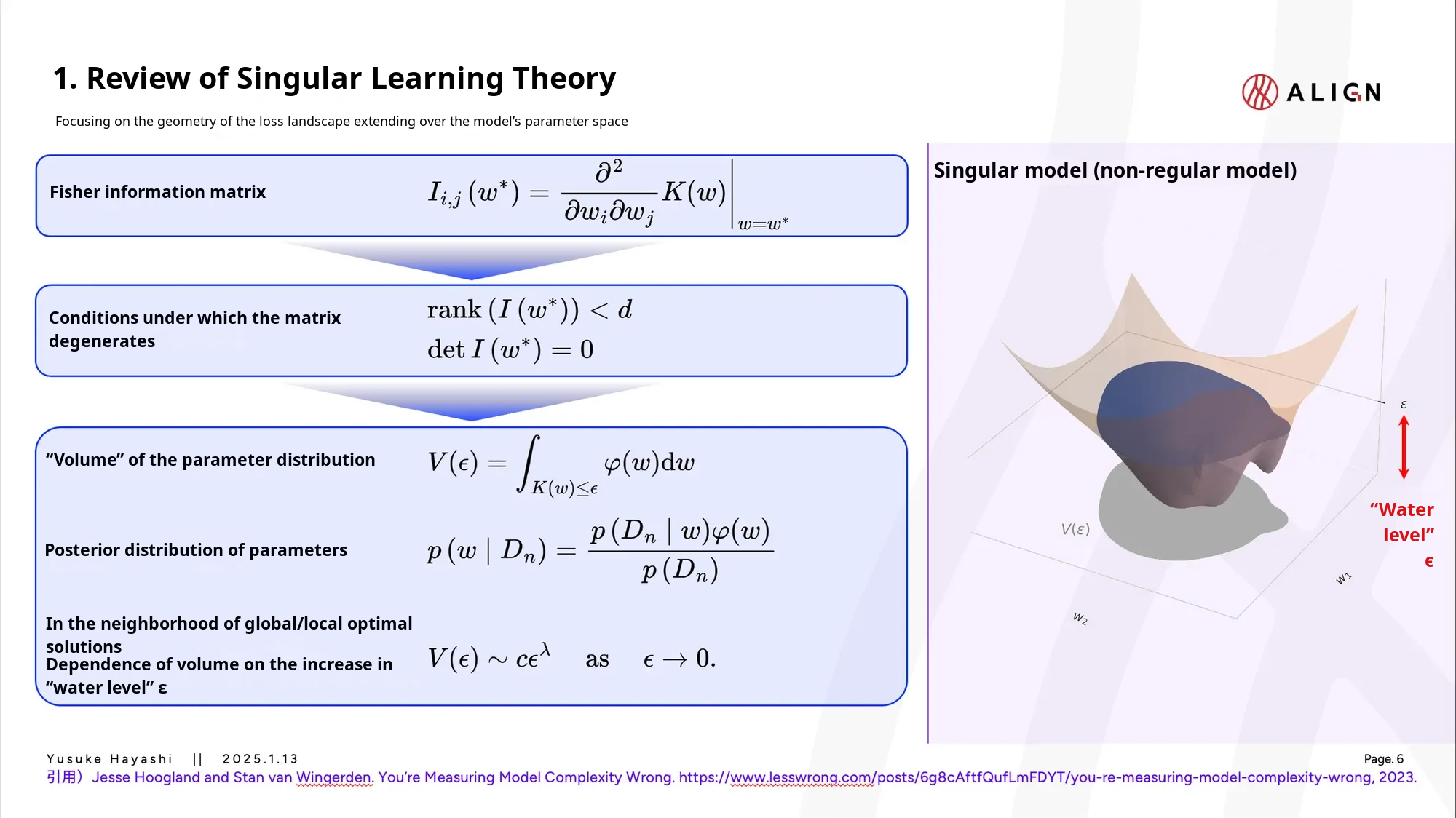
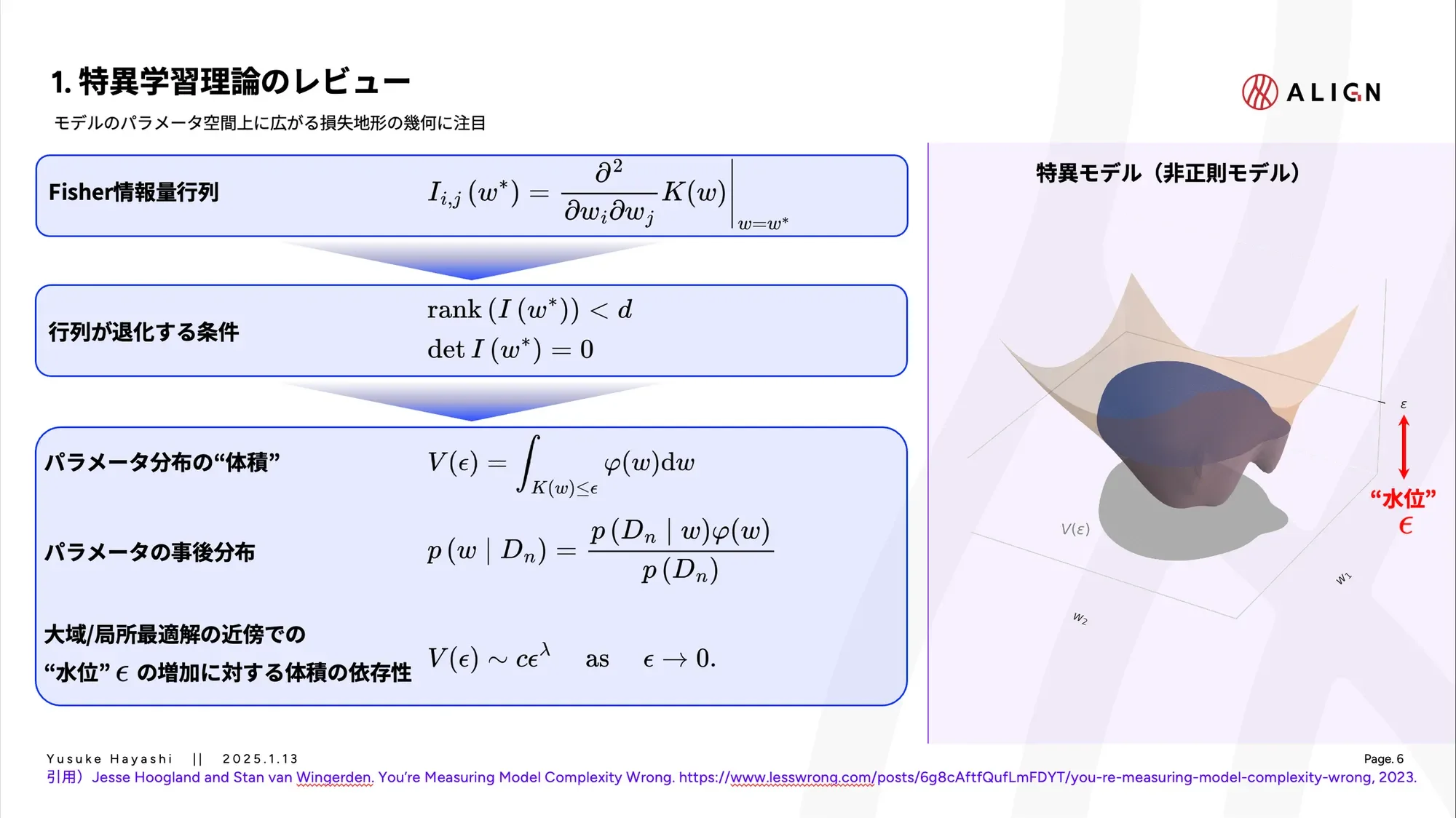
While in regular models the Fisher information matrix 𝐼(𝑤) is a positive definite matrix (with a non-zero determinant), in singular models it degenerates (its determinant is zero). What on earth happens when the Fisher information matrix 𝐼(𝑤) degenerates? Here, let us introduce a new metric 𝜆 to measure the “flatness/degeneracy” of the loss landscape. If we let 𝑉(𝜖) be the volume in the neighborhood of the set of singular points (from local optima to global optima) on the loss landscape, 𝑐 be a constant, and 𝜖 be the allowable error (the “water level”), we can see that the metric 𝜆 serves as an indicator of the volume growth rate, telling us at what pace the volume 𝑉(𝜖) increases as the “water level” rises on the loss landscape. In fact, between regular models—where the loss landscape becomes a convex function near the global optimum—and singular models—where the loss landscape becomes a non-convex function near the global optimum—the speed of this volume growth is distinctly different. (Because the loss landscape of a singular model is “flattened/compressed” near the global optimum, it might be intuitive to see that its volume growth rate will be slower compared to a regular model.)
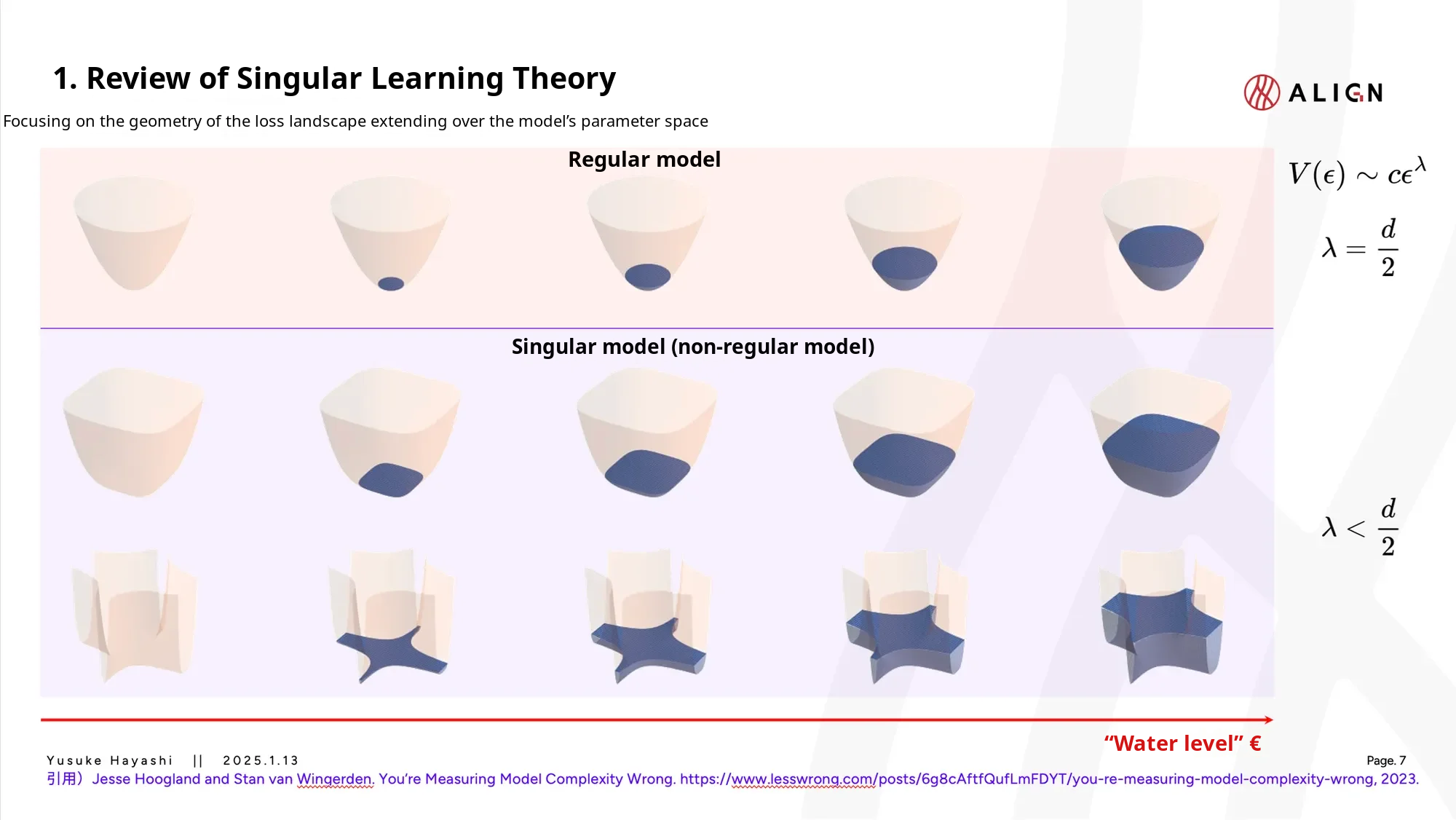

In this way, because the loss landscape of a singular model is “flattened/compressed” near local to global optima compared to that of a regular model, the speed of volume growth is slower. In fact, as explained in the next section, this speed of volume growth is related to a certain kind of “cleverness” of the model.
2. Learning Coefficient (RLCT) and Its Role
The learning coefficient (RLCT: Real Log Canonical Threshold) is used as an indicator to measure “complexity” in singular models. The learning coefficient is a value that quantitatively indicates the model’s generalization performance and information-geometric properties. Its mathematical definition is as follows:

Here, 𝑉(𝜖) is the volume in the neighborhood of the global optimum introduced in the previous section. In fact, the metric 𝜆 for the volume growth rate introduced in the previous section is called the RLCT, or the learning coefficient. And it is known that a lower value of this learning coefficient 𝜆 indicates that the model is “simpler,” which tends to result in higher generalization performance.
According to the formulas of SLT, the free energy of a singular model (the trade-off between the model’s information capacity and complexity) is expressed as follows:
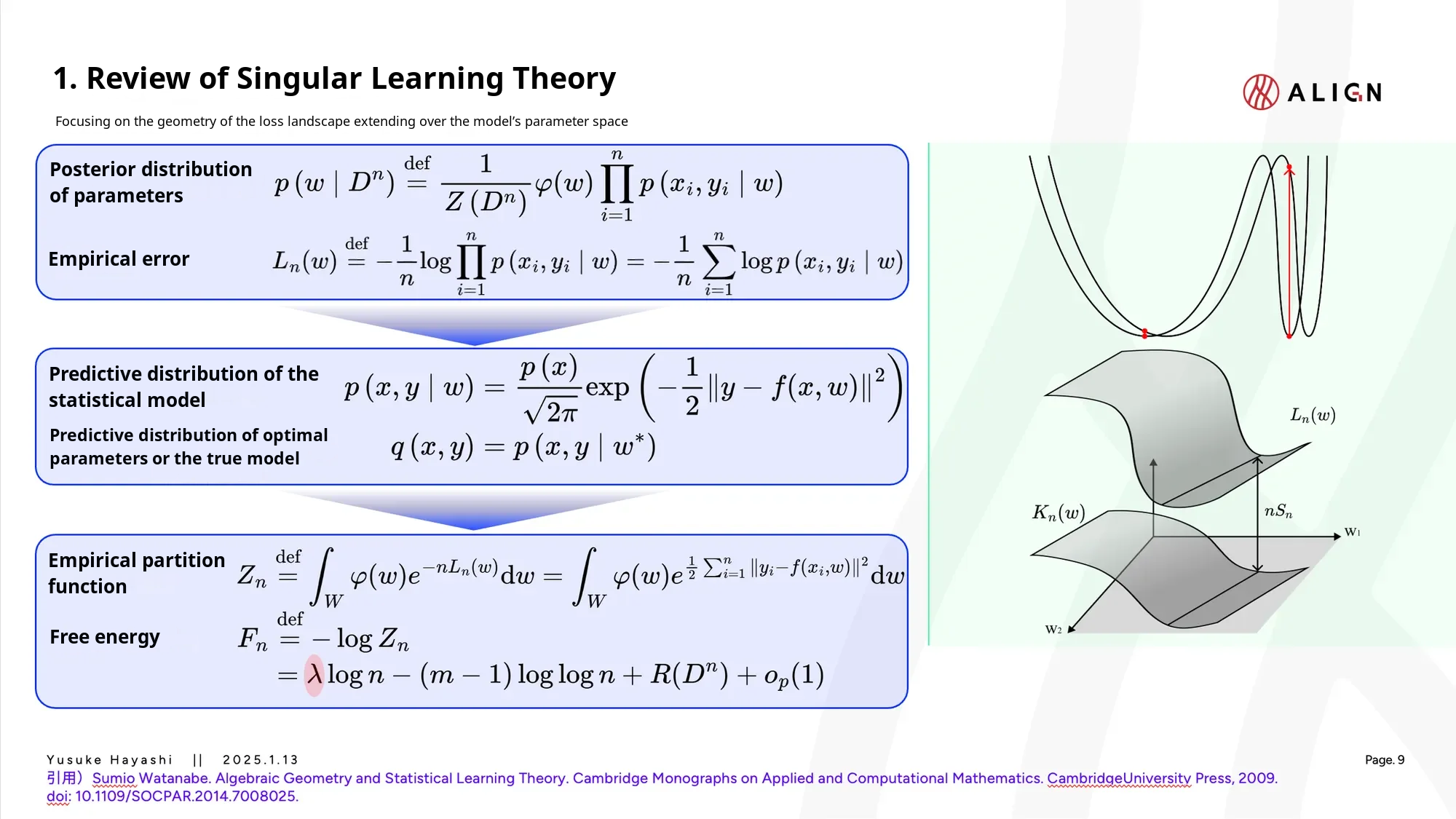
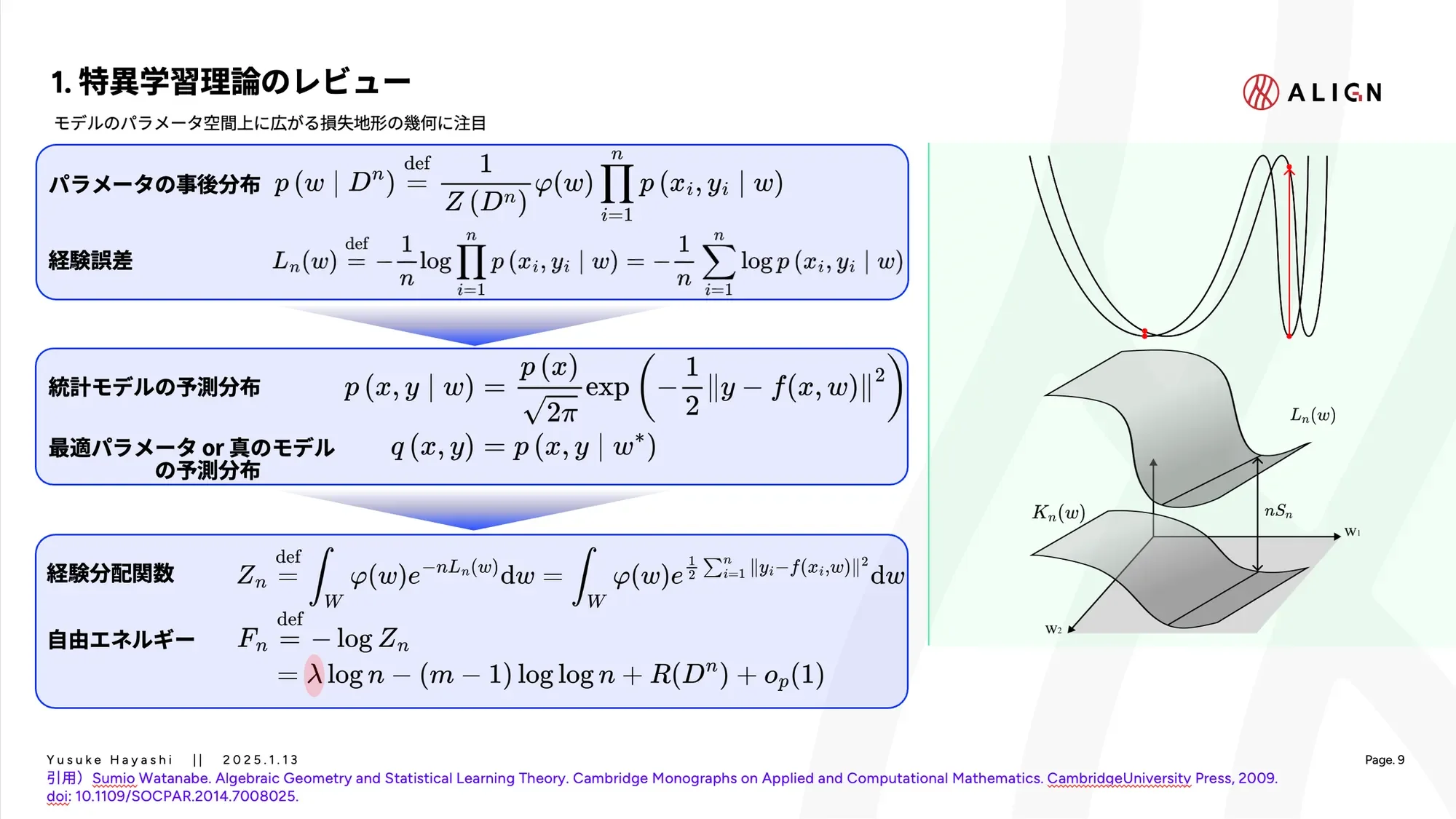
This formula (free energy) shows how the model balances complexity (𝜆 𝚕𝚘𝚐 𝑛) and accuracy (𝑅(𝐷ⁿ)) in the process of adapting to data. This balance is the key that underpins the generalization ability of neural networks. In other words, the goal of learning is to capture patterns contained in data with an appropriate complexity (𝜆)—neither too simple nor too complex—without excess or deficiency; and it can be said that singular models such as neural networks have a stronger ability to suppress this complexity (are more “clever”) compared to regular models.
3. Further Potential of Singular Learning Theory
SLT is not merely a mathematical theory; it also leads to applications that enhance AI safety and reliability. For example, it is considered useful for addressing challenges such as:
• Understanding phase transitions: Predicting and controlling behaviors where the model’s learning curve suddenly changes during training.
• Geometric analysis of the loss landscape: Technologies to search for unknown singularities and more safely control AI behavior.
• AI alignment research: Establishing design methods that integrate model safety and ethical considerations.
In this installment of the ALIGN Webinar Series, Jesse Hoogland, an expert in Singular Learning Theory, will explain this theory from the perspective of AI safety. For deep learning researchers, undergraduate students, and graduate students, this may be an eye-opening opportunity for discovery.
Event Details
 ALIGN Webinar #12 Jesse Hoogland : Singular Learning Theory for AI Safety
• Title: ALIGN Webinar #12 Jesse Hoogland : Singular Learning Theory for AI Safety
• Date & Time: January 15, 2025, 10:00–11:00 (JST)
• Host: AI Alignment Network (ALIGN)
Participation is free (advance registration required)! If you want to explore new possibilities for AI and learn cutting-edge theory, please be sure to register.
👉 Click here for webinar registration
This article is reprinted from the ALIGN Blog (January 13, 2025). It has been posted on a test site to verify whether tomola can be used as ALIGN’s blog. Original: https://www.aialign.net/blog/align-webinar-12-jesse-hoogland-singular-learning-theory-for-ai-safety
ALIGN