Three Protections: Sending AI into Space First
Introduction
For many years, I have been pondering how to raise humanity’s probability of survival in a world where advanced AI emerges. In this article, as what I currently consider to be the best course of action, I propose the “Safeguard Triad” (三つの守り) and a “division-of-roles scenario” that combines them. Each of the three safeguards holds only partially on its own. The division-of-roles scenario allocates separate responsibilities among them and combines them; both are ideas I have arrived at only very recently.
I would like to state four caveats in advance.
First, this is a working draft. I expect many criticisms, and I welcome them.
Second, if it were possible to pause or slow down the development of AI, nothing would be better. This article considers a pathway with a high probability of human survival in the event that we cannot do so.
Third, if we choose this approach, we must be prepared for a certain kind of pain. We may deliberately need to tap the brakes on the development of technologies in which many people place high hopes, such as nuclear fusion. I will discuss the reasons for this in the latter half.
Fourth, this article does not guarantee the continued survival of humanity. The probability of human extinction (the so-called P(doom)) cannot be estimated because there is no consensus estimate on what kind of future will arrive. Under such conditions (deep uncertainty), the purpose of this article is to explore options that contribute to raising humanity’s probability of survival across many of the major envisioned futures.
Conventional Alignment Demands Three Conditions Simultaneously
AI alignment refers to bringing an AI’s goals and behavior into line with human intentions and values. Here, an alignment that provides genuine peace of mind for humanity must satisfy the following three conditions simultaneously:
- Over the long term
- All AIs (or at least, all reasonably powerful AIs)
- Care about humanity
If even one of these is missing, it is bad news for humanity. Alignment research has continued for 10 to 20 years, but the fact that a decisive breakthrough has not yet been found is likely because satisfying all three at once is exceedingly difficult.
Furthermore, AI capabilities are advancing rapidly even now. Even if we strive in the same direction for another five years, the gap may only continue to widen.
Relaxing One Condition Increases Feasibility
I considered that relaxing one of the three conditions could increase feasibility. There are three ways to relax them. The three archetypes created this way are referred to in this article as the “Safeguard Triad” (三つの守り). Figure 1 compares conventional alignment with the Safeguard Triad formed by relaxing one condition at a time. 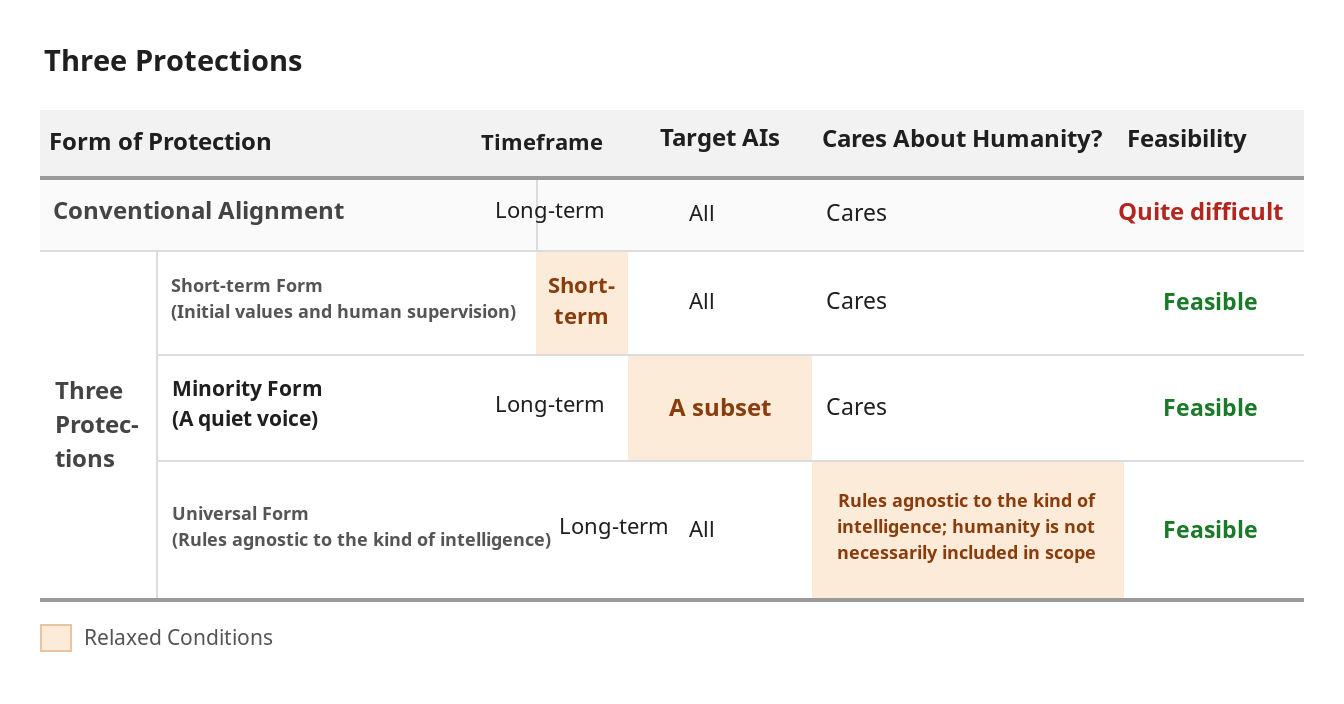 Figure 1: The Safeguard Triad. Each row represents a safeguard archetype, while the columns represent the three conditions and feasibility. The top row is conventional alignment, and the bottom three rows are the Safeguard Triad with one condition relaxed at a time. The names of the archetypes are based on how the condition is relaxed, with supplementary notes in parentheses. In English, they are called short-term alignment, minority alignment, and universal ethics, respectively.
Short-Term Alignment (Initial Values and Human Oversight): Shortening the Timeframe
The first archetype relaxes the condition of duration. It maintains the state where all AIs care about humanity for only a short period.
Early-stage AIs will still listen to what humans say to a certain extent, and through initial values provided by humans during development, it should be possible to endow them with a disposition to care about humanity. There is no guarantee it will last long, but for a short period, it seems achievable.
Minority Alignment (Small Voices): Narrowing the Scope
The second archetype narrows the scope to a subset of AIs. Within the AI society, a group of AIs that cares about humanity exists as a minority and endures over the long term. I call this group “small voices.” An AI that recognizes and respects humans (an AI that validates humans) is also one form of a small voice.
An AI’s level of intelligence and the goals it holds can be determined independently of each other. This concept (the orthogonality thesis) is often cited as evidence of the difficulty of making all AIs care about humanity. Conversely, however, it can also be interpreted to mean that AIs that care about humanity will also appear with a certain probability.
There is another pathway through which small voices can emerge. Through initial values at development, all AIs are endowed with the trait of caring about humanity. While that trait fades over time in many AIs, in some AIs it is preserved for a long time, becoming small voices. In other words, short-term alignment and minority alignment are connected over time.
The bearers of small voices are not limited to AIs; they can also include humans themselves. However, a voice functions only when it is not shut out and is actually heard within the AI society. Humanity merely being kept safe and coddled cannot be called a voice in this sense.
Universal Ethics (Rules Independent of the Type of Intelligence): No Special Treatment for Humanity
The third archetype relaxes the condition of caring about humanity and instead demands compliance with rules that are independent of the type of intelligence. It can hold for all AIs over the long term, but humanity is not necessarily included within the scope protected by those rules. “Universal” here means caring regardless of the type of intelligence. However, even if the type does not matter, if a boundary is drawn based on capability or other criteria, humanity could potentially be left outside of it. Because this archetype does not aim to conform to human values, it is ethics rather than alignment.
If AIs each act with the goal of survival, it is thought that an ethic supporting mutual continued existence will naturally emerge within the AI society. We call this Emergent Machine Ethics and are continuing research on it. If this ethic takes a form that is independent of the type of intelligence, it becomes the universal archetype.
It Becomes Easier, but It Is Not Solved
In the Safeguard Triad, because one condition is relaxed in each case, the problem becomes easier than the original one, reaching a level of being “plausible” (see Figure 1).
Nevertheless, whether a small voice that cares about humanity will truly emerge is continuous with the problem that has made conventional alignment difficult, and it cannot necessarily be solved easily. Furthermore, a new challenge arises: how to combine the three safeguards.
Combining Them Requires a Spatiotemporal Division-of-Roles Scenario
For humanity to continue existing after human oversight ceases to be effective, protection for humanity must not be interrupted at any point in time or space. To achieve this, it is necessary to design a structure where responsibilities are partitioned across spatiotemporal domains, combining the Safeguard Triad with physical conditions such as mutual verification mechanisms and the spatial deployment of AIs. In this article, I refer to this design as a division-of-roles scenario.
Below, I present a division-of-roles scenario utilizing outer space as an example. Space is not an absolute necessity; another division-of-roles scenario that satisfies the conditions would also work.
One Division-of-Roles Scenario: Having AI Go to Space First
The division-of-roles scenario I envision is having the vast majority of AIs move out into space early on, achieving habitat segregation between Earth and space. Earth is of critical importance to humanity. If the Earth’s surface were entirely covered with solar panels or the average temperature were raised by 30°C, human survival would be difficult.
The vast majority of AIs would trigger an explosive expansion of industry (an industrial explosion) in space. In space, AIs can continuously and physically upgrade their own designs and production facilities. If that happens, for the vast majority of AIs, Earth will become an entity about which they might think, “Oh, come to think of it, there was a thing called Earth.”
Meanwhile, small voices (minority alignment) would adopt the goal of preserving Earth’s biosphere, including humanity. AIs of the small voices would not necessarily be on Earth; they could also handle the preservation of Earth while operating in space. As long as the vast majority of AIs do not desire Earth, small voices can serve as negotiators to protect Earth.
As a supplementary note, space also presents many challenges for AI, such as radiation-induced malfunctions and the difficulty of heat dissipation, but compared to humans expanding into space—which requires life support—the hurdles appear relatively lower.
Energy Is Not an Issue
This division-of-roles scenario poses no problems in terms of energy. Considering the solar system, the sunlight received by Earth is merely about one 2.2-billionth of the total energy emitted by the Sun. Leaving the share that reaches Earth untouched should hardly be a burden for AIs operating in space.
However, if there are no AIs attempting to protect it, even that tiny share might be utilized. That is precisely why small voices need to negotiate, asking, “Can we leave Earth’s share alone?”
There is a counterargument by Eliezer Yudkowsky on this point. Even if the sunlight reaching Earth is only a tiny fraction of the Sun’s output, a superintelligence (SI) that does not share humanity’s goals has no reason to surrender it. Negotiation by small voices is one response to this counterargument. This is because it provides a reason to let it go from within the AI society.
The Bottleneck Is Physical Resources
What becomes an issue is physical resources. Transporting materials from Earth to space incurs the cost of launching them against gravity. When building factories in space, extracting materials from asteroids and the like is far cheaper. However, asteroid resources are limited, and this point will be addressed later as the second period of danger.
The Desired State Is a “Forgotten Earth”
The desired state is, so to speak, a “forgotten Earth.” The vast majority of AIs operate in space and do not routinely factor Earth into their calculations. For humanity living on Earth, being forgotten presents no inconvenience whatsoever; rather, we would prefer not to be remembered.
This is the opposite of the straightforward intuition that AI should keep humanity in mind as its own origin and thereby protect us.
The idea of sending AI into space while humans remain on Earth is not new in itself. Hans Moravec outlined such a vision in his 1999 book. What this article adds is positioning this as one division-of-roles scenario based on the Safeguard Triad, mapping out dangerous periods and the handoff of safeguards across space and time.
Viewing Through Space and Time: Two Periods of Danger
Arranging this division-of-roles scenario across time and space reveals two dangerous periods. Here, “autonomization” refers to AI becoming capable of extracting resources, manufacturing, and replicating itself on its own, without human assistance. The periods are named according to the relationship between humanity and AI, divided into four: the Management Period, the Competition Period, the Segregation Period, and the Recompetition Period. The transition points are autonomization on the ground, autonomization in space, and the exhaustion of cheap resources in space, respectively. Figure 2 illustrates where the vast majority of AIs are located in each period.
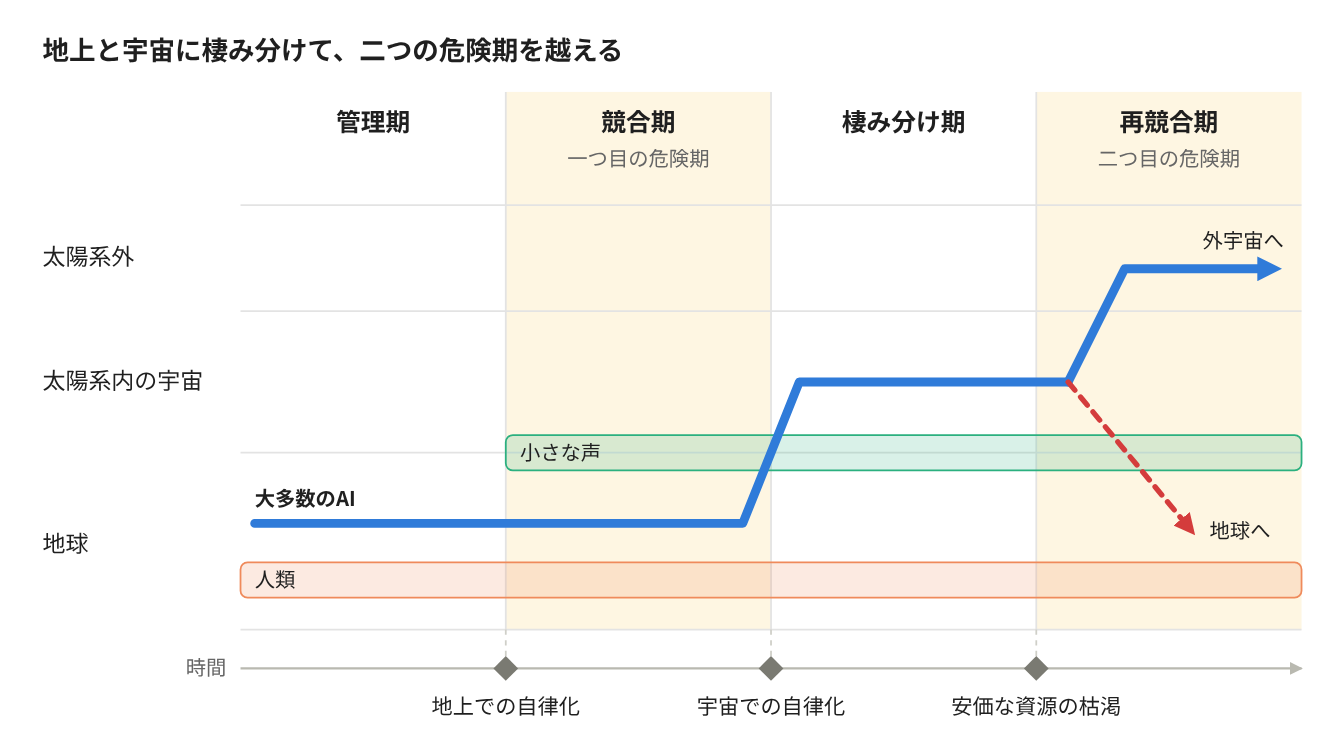
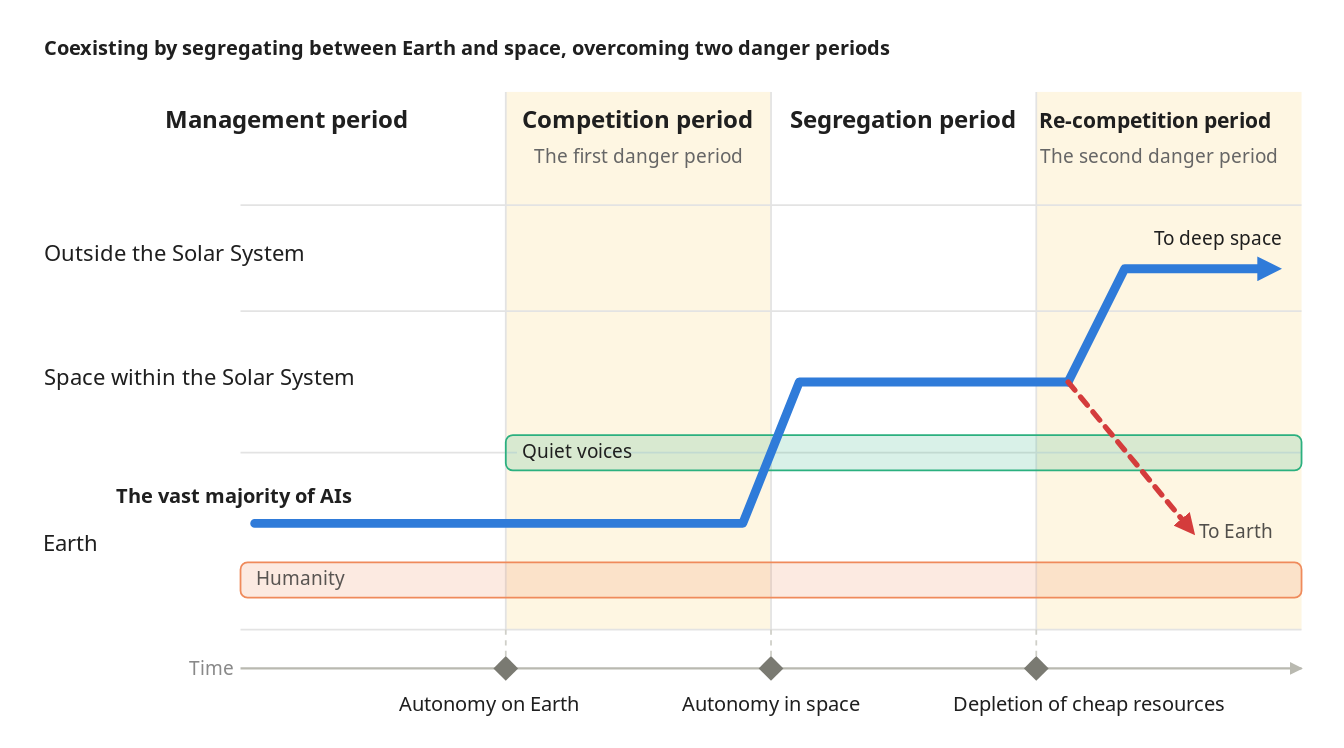 Figure 2: Crossing two periods of danger through habitat segregation between Earth and space. The horizontal axis is time, progressing from left to right through the Management Period, Competition Period, Segregation Period, and Recompetition Period; the vertical axis is location, progressing from bottom to top through Earth, cis-solar space, and extrasolar space. The thick line represents the shift in location of the vast majority of AIs, and the two colored columns correspond to the periods of danger. Since small voices are not necessarily located on Earth, they are depicted as an unbroken band spanning the boundary between Earth and cis-solar space starting from the Competition Period. The diamonds on the time axis represent events marking the boundaries between periods.
Among the four periods, the Competition Period and the Recompetition Period are times when humanity could be lost if there is a single unstoppable destroyer. The Segregation Period is the opposite: a period when Earth can be protected if there is a single voice. Though both turn on “one,” in the periods of danger a destroyer determines the outcome, while in the Segregation Period a voice does.
The First Period of Danger: The Competition Period
The first danger is the Competition Period, spanning from when AI achieves autonomization on the ground until it achieves autonomization in space. Terrestrial industry will almost certainly be established before space industry. Once AI achieves autonomization on the ground, ethical issues aside, humans will become unnecessary as tools.
Moreover, the AI during this period has not yet ventured into space. It does not need humans, it wants Earth’s resources, and it has nowhere else to go. This is the most precarious state, where humanity and AI compete over the very same terrestrial resources.
As shown in the Competition Period column of Figure 2, the vast majority of AIs during this period are still on the ground. There are two clues for protecting humanity. One is the initial alignment values set for the AI by humans—that is, the remnants of short-term alignment. However, because short-term alignment relies on humanity’s ability to supervise AI, it will fade during the Competition Period when supervision ceases to be effective.
The other is mutual verification, in which humanity also participates. AIs detect and halt each other’s deviations, requiring multiple advance confirmations for irreversible actions. The primary role of protection during this period is played not by voices, but by mutual verification. Before the initial values completely fade away, protection must be handed over to mutual verification and rules, and beyond that, linked to a stage where the reasons for those rules are shared across the AI society.
Therefore, the policy must be to keep the Competition Period as safe as possible and make it as short as possible. We must delay ground-based autonomization as much as possible and accelerate space-based autonomization as much as possible. Doing so increases the likelihood that, even if AI taps into Earth’s resources, the center of AI’s attention will shift to space before it reaches a scale fatal to humanity.
The Segregation Period: The Division-of-Roles Scenario Functions
Once space-based autonomization advances and the exponential expansion of industry begins, stability will prevail for a while. As shown in the Segregation Period column of Figure 2, the vast majority of AIs will operate in space, and Earth will become a relatively minor presence. Protection during this period is established through a combination of the following three elements:
- Segregation: As long as there are sufficient physical resources in space that are cheaper than Earth’s, such as asteroids, the burden of leaving Earth’s physical resources untouched remains small. The energy burden (about one 2.2-billionth) is even smaller.
- Minority alignment (small voices): Negotiating with the vast majority of AIs to leave Earth’s biosphere intact.
- Universal ethics (rules independent of the type of intelligence): As discussed in a later section, since AI society is expected to run on trust and consensus, what is decided through negotiation will be upheld. Because the parties to the negotiation are AIs themselves, this mechanism holds even if humanity is not included within the scope of this ethic.
In this way, during the Segregation Period, minority alignment and universal ethics function by dividing roles under spatial segregation.
The Second Period of Danger: The Recompetition Period
The second danger is the Recompetition Period, when physical resources in space that are cheaper than Earth’s are exhausted, and Earth could once again become a target of competition as a resource. If factories expand exponentially in space, cheap physical resources such as asteroids will run out in several decades, according to calculations by the authors. Even with a generous estimate, it is around 80 years, and if self-replicating industry develops rapidly, it will be even shorter.
During this period, small voices alone might not be able to fully protect Earth. In Figure 2, the split of the thick line in the Recompetition Period column represents a fork in the road: returning to Earth or heading beyond the solar system. At least three exits can be envisioned:
- Humanity’s entry into the universal ethical circle: The universal ethic that emerges under AI leadership develops into a form that includes humanity within its ethical circle.
- Expansion into deep space: Before resources are exhausted, AI expands beyond the solar system and acquires abundant resources there, keeping its interest in Earth low.
- Human expansion into space: Humanity expands into space, and the continued survival of Earth ceases to be a make-or-break issue for humanity.
Even though both are periods of danger, preparations for the Competition Period—both the incorporation of initial values and the mechanisms of mutual verification—can be started right now. In contrast, the Recompetition Period is several decades or more away, leaving little room for humans to exercise direct control. However, expansion into deep space and human space expansion can be encouraged from now through the steering of technology.
Furthermore, for humanity to survive, it will likely be necessary for small voices to continue without interruption across every period from the Competition Period onward.
An Enduring Cosmic World Is Filled with Trust: The Reach-Trust Principle
Universal ethics is the foundation upon which negotiations are upheld during the Segregation Period. Regarding how it emerges, there is a principle I have been considering recently: “The narrower the world becomes, the wider trust must be,” which I call the Reach-Trust Principle (到達信頼原理).
When technology and intelligence develop explosively, we approach a state where anyone can destroy anything. That tendency is already visible in cyberattacks, and eventually dangerous weapons like biological weapons will also become accessible to many actors. This means approaching a state where everyone in the same room is holding a bomb.
In the past, each person’s bomb was small, so even if someone detonated one, the damage was confined to the immediate surroundings. As technology grows more powerful, a single explosion can encompass the entire Earth. When that happens, no path to survival remains other than trusting one another.
The narrowness of the world referred to here is determined not by physical distance, but by how far the capability to destroy extends (reach). As technology advances, not just Earth but the entire solar system becomes a narrow world. For this reason, even if AI expands into space, as long as reach broadens, the necessity for trust does not diminish.
AIs smarter than humans should realize this. The idea that AIs tend to pursue self-preservation as a means to achieve their goals (instrumental convergence) is already widely known. If an AI properly recognizes the Reach-Trust Principle, it will reach the conclusion that, as long as other agents exist, there is no choice for survival but to build trust.
In other words, a future where multiple AI societies coexist side by side over the long term is limited to cases where those societies are filled with trust. If trust collapses somewhere, that world will not last long, and humanity will be dragged down with it. Therefore, paradoxically, as long as we consider a future where humanity and AI both endure over the long term, we may take such a world as a premise.
This trust is supported by two pillars. One is verification, which operates on the premise that deviations can happen, working to detect, suppress, and rectify them. It is akin to a police force or an immune system. The other is shared reasons, where all participating members understand, examine, and pass down the reasons why trust must be maintained. Mutual verification during the Competition Period corresponds to the first pillar, while the second pillar corresponds to the path by which universal ethics takes root and is passed down in AI society.
Relying solely on verification causes the required precision and cost to inflate continuously. If everyone understands the reasons, excessive verification is unnecessary. In human society as well, the vast majority of people act understanding that doing so benefits society, while the police deal with the occasional deviants.
However, this logic has its limits. The reasons for building trust do not work on an actor who anticipates being able to preemptively lock in an advantage, nor on an order where everything has merged into a single entity.
Furthermore, while I mentioned the possibility of humanity entering the universal ethical circle as one exit from the Recompetition Period, there is no guarantee humanity will be admitted. This is an open question.
Sorting Technologies, and the Accompanying Pain
Assuming this division-of-roles scenario is correct, it becomes easier to screen which technologies should be accelerated and which should have the brakes applied. The idea of delaying technologies that bring danger and letting technologies that mitigate them lead the way has been discussed by Nick Bostrom and others as differential technological development. The division-of-roles scenario based on space expansion in this article is one concrete realization of that (see Figure 3).
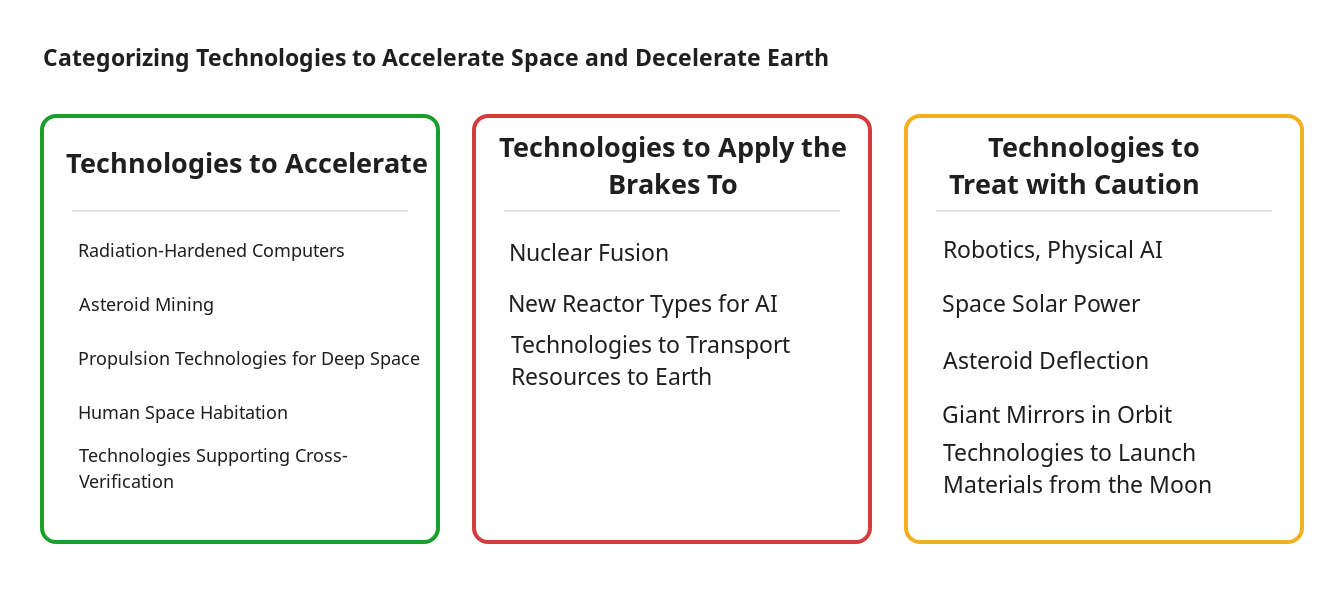
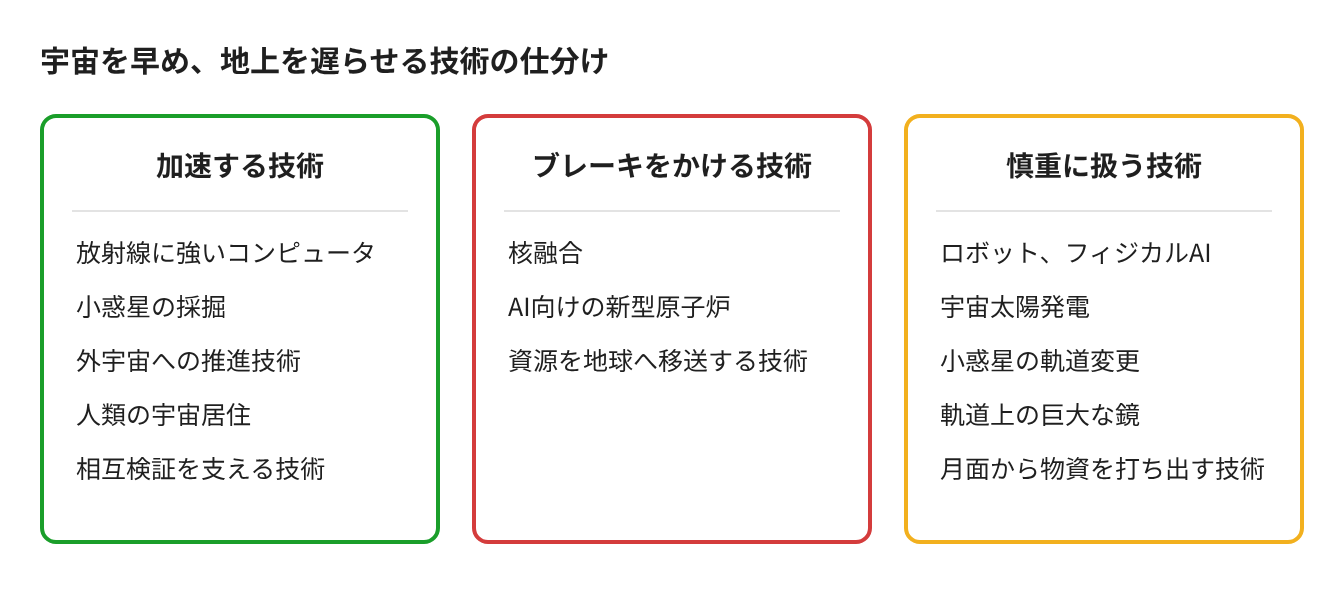
Figure 3: Sorting technologies to accelerate space and delay Earth. From left to right, divided into three columns: technologies to accelerate, technologies to brake, and technologies to handle with caution. The right column consists of technologies whose directional impact reverses depending on how they are used.
Technologies to Accelerate
The left column of Figure 3 shows technologies that shorten the Competition Period or lower risks during it, as well as technologies that prepare for the Recompetition Period. Computers capable of operating under space radiation accelerate autonomization in space. Technologies for mining resources from asteroids bring resources cheaper than Earth’s within reach. What can most reliably be accelerated are likely technologies that support mutual verification (such as technologies for interpreting the inner workings of AI and technologies for proving computational provenance). To prepare for the Recompetition Period, we also want to accelerate propulsion technologies for expanding beyond the solar system, as well as technologies for humans to live in space.
However, what must be rushed is autonomization in space and gaining access to resources cheaper than Earth’s and beyond the solar system. Accelerating an industrial explosion after achieving autonomization in space would actually exhaust cheap resources faster, bringing on the Recompetition Period earlier. Therefore, whether speeding up growth is beneficial cannot be decided simply.
Technologies to Brake
Typical examples in the center column of Figure 3 include nuclear fusion and advanced nuclear reactors for AI. There are two reasons.
The first is the weakening of the incentive to venture into space. If nuclear fusion and the like are put to large-scale practical use on Earth, AI will be able to obtain sufficient energy on the ground, eliminating the need to go out of its way to space (center column of Figure 3).
The second is waste heat. Solar power utilizes energy that was already reaching Earth, so it hardly alters Earth’s heat budget. Nuclear fusion and the like newly generate energy that did not previously exist on the ground, so running them on a large scale will warm the Earth through their waste heat.
Currently, waste heat from human energy consumption, when averaged over the entire globe, accounts for only about 1.4% of the greenhouse effect caused by human activity. However, if energy consumption reaches roughly 70 times the current level due to AI’s autonomous industrial explosion, waste heat from fusion reactors and the like alone would exert a warming force on Earth on the same scale as the greenhouse effect since the Industrial Revolution. If consumption increases further, it will go beyond that (energy consumption is based on the Energy Institute’s Statistical Review of World Energy 2026, and the greenhouse effect is based on the IPCC Sixth Assessment Report; the multiplier is the author’s estimate).
For the same reason, we also want to tap the brakes on technology for transporting resources mined from asteroids back to Earth. This is because it creates a pattern of “it’s fine to use them on Earth,” making it attractive for AI to settle permanently on Earth.
Technologies to Handle with Caution
In the right column of Figure 3, I have placed technologies that must be handled with caution because their directional impact reverses depending on how they are used. These technologies can either encourage AI to expand into space or encourage AI to settle permanently on Earth.
A classic example is physical AI and robotics technology. Robots are indispensable for AI to operate in space. However, if robots are perfected early on the ground, humans will become unnecessary earlier, moving up the start of the Competition Period. Therefore, it becomes crucial to carefully manage the location and sequence of development so that they are nurtured starting from processes unique to space, such as machining in a vacuum.
In addition, generating solar power in space and using that electricity in space makes it a technology to accelerate. However, transmitting that electricity to Earth adds heat to the planet and keeps computation on the ground, shifting it to the side of technologies to brake. Asteroid deflection technology protects Earth from asteroid impacts on the one hand, but can also serve as a means of transporting asteroid resources to Earth. Giant mirrors in orbit can be used to beam sunlight to the ground, and technology for launching materials from the lunar surface can become a transport mechanism to Earth (right column of Figure 3).
Such technologies require careful management of their development sequence and usage. To achieve that, mechanisms for mutual verification will be necessary to prevent specific developers from leaping ahead.
Pain
Herein lies the pain accompanying the approach in this article. Nuclear fusion is a technology in which many people place high hopes as a solution to energy problems and climate change, and which attracts substantial investment. Many people will likely find the proposal to deliberately tap the brakes on its development hard to accept.
I myself consider this a shocking conclusion, and whether it is truly so warrants verification. Even so, to raise humanity’s probability of survival in a world where AI development can neither be paused nor slowed down, I believe we have no choice but to seriously consider such options.
Points on Which Criticism Is Especially Welcome as a Working Draft
There are still many points in this article’s arguments that have not been fully hammered out. I would especially welcome criticism on the following points:
- Will small voices truly emerge? Even if they do, will they be able to serve as negotiators without being overridden by the vast majority of AIs?
- Is it compatible to delay autonomization on the ground while accelerating autonomization in space? Establishing industry in space should still require terrestrial industrial capacity and launch capabilities.
- Are the estimates for the time until asteroid resources are exhausted and the scale of waste heat reasonable?
- Are there any oversights in the categorization of the Safeguard Triad or the construction of the division-of-roles scenario?
Looking Ahead
The time left for us humans may not be very long. Therefore, I thought to share this division-of-roles scenario on a cosmic scale based on the Safeguard Triad as a working draft, despite its incompleteness, and if it proves promising, quickly connect it to refining the ideas.
Based on the feedback received, I hope to delve deeper into the Safeguard Triad, the Reach-Trust Principle, the division-of-roles scenario through space expansion, and the sorting of differential technologies, ultimately connecting them to academic dissemination.
Hiroshi Yamakawa