How Far Will AI’s Power Demand Rise? A Preliminary Examination of the “AI Power Problem”
Right now, the world is in the midst of an AI development race. Hardware for AI is being added at an unprecedented pace, and what is beginning to surface is the “AI power problem.” Big Tech companies are rushing one after another to build AI data centers and are also moving to secure power sources. Governments around the world have also begun committing increasingly large budgets to expand domestic AI compute.
Power consumption serves as a quantitative metric for this hardware buildup. The amount of electricity (in watt-hours, Wh) required to train and run (inference) AI models reflects how much energy humanity is pouring into AI. Just how far will AI’s electricity consumption rise in the future?
There are two opposing views on this topic. Some commentators argue that the sharp increase in power consumption driven by AI is merely transitory, and that as efficiency improvements and miniaturization progress, power consumption could even decrease over the long run. On the other hand, as seen below, many forecasts predict that exponential growth in power consumption will not stop anytime soon. Behind this lies the perspective that because AI’s impact on industry and national security is so immense, the “compute race” among nations and corporations will only intensify.
The AI Alignment Network (ALIGN), a general incorporated association, has examined the long-term risks posed by AI, conducting research, building community, and fostering dialogue—including on technical countermeasures. Within this scope, we also view AI’s power problem (and broader environmental issues) as one of these long-term risks, and have prepared this article primarily to gain perspective on the issue. This article aims to achieve the following three goals:
- Introduce representative estimates regarding AI power demand
- Examine the evidence behind both viewpoints: that AI power demand will grow exponentially, and that it will not
- Through the above, gain perspective on how to view the AI power problem moving forward.
Note: AI tools were utilized during the research phase for this article, but the author directly consulted the sources cited. The text was also written under the author’s own responsibility.
1. Current State and Projections of AI Power Consumption
1.1 Current Data Center Electricity Consumption Accounts for Around 1–2% of the Global Total
First, what does the current snapshot look like?
According to the International Energy Agency (IEA), global electricity consumption from “data centres, cryptocurrencies, and artificial intelligence” was 460 TWh in 2022, representing approximately 2% of worldwide electricity consumption. Looking at Japan and the United States:
- While there are no up-to-date statistics for Japan, a 2018 report by the Japan Science and Technology Agency (JST) indicated that power consumption by domestic data centers was 14 TWh, representing 1.4% of the nation’s total electricity consumption. For 2022, other organizations have produced lower estimates, showing some variance, but both figures remain below the global average.
- In the United States, which hosts the largest number of data centers globally (with 33% of the world’s 8,000 data centers located in the US, according to the IEA), data center power use reportedly reached 176 TWh in 2023, accounting for 4.4% of total electricity consumption.
While there are countries where corporate data centers are concentrated and account for an unusually high share—such as Ireland (21% in 2023: source)—the global figure sits at around 2%. Even if this were to double, it would still fall short of the power consumed by air conditioning, which is said to account for roughly 10%. Therefore, the issue is not the power consumption snapshot at this present moment, but rather how fast and to what extent it will grow.
1.2 Exponential Hardware Growth Drives a Surge in Power Demand
At what pace is it projected to grow from here? The IEA’s “Electricity 2024 Report” from January 2024 projected that global electricity consumption from “data centres, cryptocurrencies, and artificial intelligence” would reach 620–1,050 TWh per year by 2026. This corresponds to an increase of 160 TWh to 590 TWh from 460 TWh in 2022, amounting to “an increase equivalent to adding at least one Sweden, or at most one Germany, to overall consumption.” Note that the 2025 edition of the same report does not provide projected growth figures limited specifically to the global IT sector.
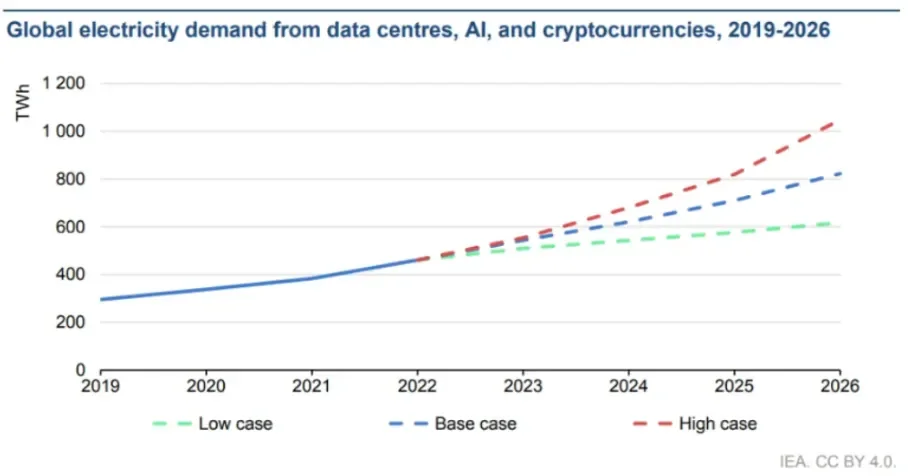 Source: International Energy Agency (IEA) – Electricity 2024 Report
In December 2024, a report commissioned by the US Department of Energy (DOE) and conducted by Lawrence Berkeley National Laboratory estimated that data center electricity consumption in the US will rise from 176 TWh in 2023 (4.4% of US total electricity consumption) to 325 TWh–580 TWh (6.7%–12.0%) by 2028.
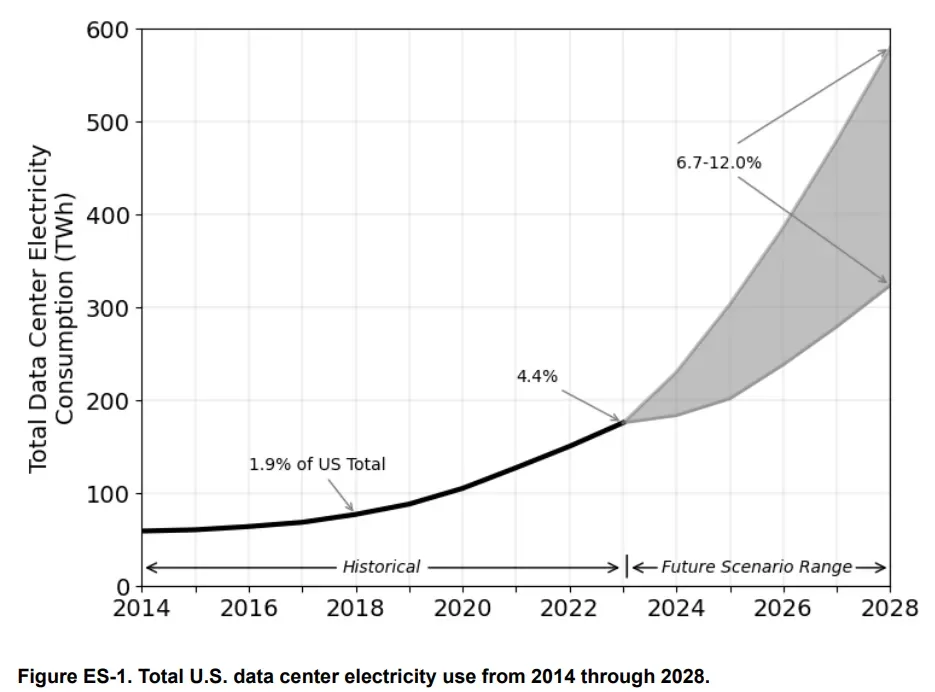 Source: Lawrence Berkeley National Laboratory, “2024 United States Data Center Energy Usage Report”
These projections of rapid growth are largely estimated from shipment trends of data center semiconductors (GPUs). A January 2025 report by the RAND Corporation in the US states that current semiconductor shipments are growing exponentially, and if this pace continues, overall power demand from global AI data centers by 2027 could double global data center power demand from 2022, approaching a scale close to California’s total generating capacity in 2022 (86 GW).
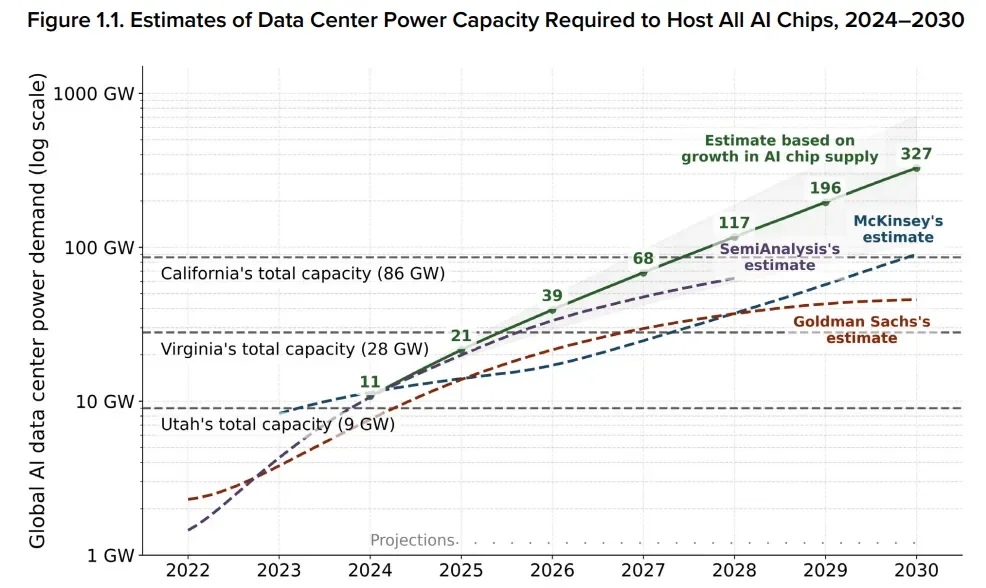 Source: RAND (2025), “AI’s Power Requirements Under Exponential Growth”
Regarding Japan, there are few projections anticipating similar “exponential growth.” For instance, in committee materials from the Ministry of Economy, Trade and Industry (METI), organizations such as the Central Research Institute of Electric Power Industry (CRIEPI) and the Research Institute of Innovative Technology for the Earth (RITE) present a range of forecasts for Japan’s total electricity demand through 2050 (not limited to data centers or IT)—ranging from staying flat at 900 TWh (the 2022 level) to growing up to 1,200 TWh. None of these, however, project an exponential surge in power demand driven by AI. As an exception, Mitsubishi Research Institute conducted its own scenario analysis in an August 2024 report, stating that power demand in the ICT sector in 2040 could be approximately 2 to 27 times higher than in 2020.
All the projections reviewed so far are based on the situation up through 2024. They do not account for developments since early 2025, such as:
- On January 21, 2025, immediately after taking office, US President Trump announced the Stargate Project with OpenAI, SoftBank Group, and others. It is reported to invest up to $500 billion (approx. 78 trillion yen) over four years into AI data centers in the US, with reports already indicating that the first data center is under construction in Texas.
- In January, the UK government published its AI Opportunities Action Plan. Among its goals is increasing the UK’s state-owned AI compute for research twentyfold by 2030.
Driven by such aggressive public investments worldwide, forecasts for AI power demand may trend higher than those made in 2024.
1.3 The Mechanics Behind Exponential Growth
Since the arrival of large language models, the compute poured into training frontier models is said to be increasing by 4–5x per year. Furthermore, as seen in the aforementioned RAND Corporation report, global AI hardware is expanding exponentially in terms of semiconductor shipments as well.
The primary backdrop to this is that AI performance is linked to the volume of computation (FLOPs) dedicated to training and inference. (1) Allocating more compute to an AI improves its performance (“scaling laws”). Consequently, under current conditions, (2) expanding hardware directly ties to competitive advantage for AI developers against rivals. Meanwhile, (3) for national governments as well, having domestic AI hardware drives industrial competitiveness, while lacking it represents a national security threat. As a result, (4) public and private investments into large-scale data centers accelerate, and (5) consequently, AI becomes even more advanced, further elevating AI’s strategic importance.
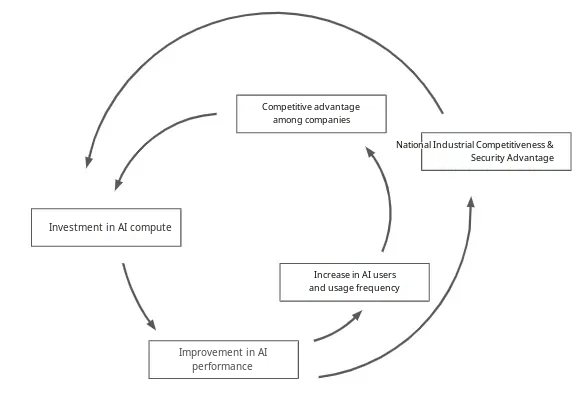 The positive feedback loop driving exponential growth in compute (Source: Created by the author)
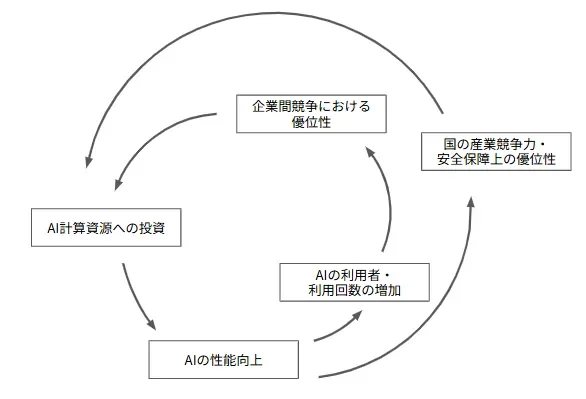
As long as this positive feedback operates, compute is expected to expand exponentially. The real questions are whether this translates directly into exponential growth in power consumption, and how long this positive feedback loop will last.
2. Arguments for “Why Exponential Growth Won’t Continue” vs. “Why It Will”
There are arguments on both sides regarding whether this exponential growth will persist.
2.1 Why Exponential Growth Will Not Continue
Commentators who believe that the exponential growth in AI power demand will not last long view current foundation model development as a transitory phase. While companies are currently building massive GPU clusters as an upfront investment, this view holds that once the technology matures to a certain degree, AI processing will converge toward more efficient chips and distributed architectures—much like how mainframes once gave way to personal computers.
It is also frequently pointed out that over the past two decades, there were multiple predictions that data center power consumption would skyrocket, yet most failed to materialize. Through cloud migration and efficiency gains, data center electricity use was kept in check, remaining below 1.5% of total electricity consumption throughout the 2010s. In 2010, Jonathan Koomey of Stanford University and Lawrence Berkeley National Laboratory showed an empirical rule that the number of computations (FLOPs) per joule doubles approximately every 1.57 years, known as “Koomey’s Law.”
On one side lies the view that AI power demand will stabilize due to reductions in the compute AI requires, coupled with drops in electricity costs per FLOP (example).
2.2 Why Exponential Growth Will Continue
In January 2025, DeepSeek, an LLM originating from China, became a major topic of discussion. DeepSeek-V3, announced the previous month, reportedly was trained using 1/11th the compute of the 405B-parameter Llama, despite having 671B parameters, thanks to architectural innovations. In the wake of DeepSeek’s impact, Jevons’ Paradox was widely discussed. This refers to the phenomenon where increases in resource efficiency actually lead to higher overall consumption of that resource. If power-saving AI hardware and algorithmic optimizations make it possible to “use AI at lower costs,” it could accelerate adoption, thereby increasing the absolute volume of power consumed.
Moreover, under current conditions, the positive correlation between performance and compute continues to hold, maintaining the incentive for AI developers to scale up models. In an article titled “Can AI Scaling Continue Through 2030?” by Epoch AI, a think tank renowned for analyzing frontier AI, the authors project that it is feasible to scale up compute by 2030 to 10^28–10^29 FLOPs—a 10,000-fold increase over the compute required to train GPT-4 in 2023.
In summary, those arguing that exponential growth in AI power will not continue believe that “efficiency will resolve the issue just as it has in the past,” whereas those arguing that it will continue believe that “foundation models are fundamentally different from past technologies.”
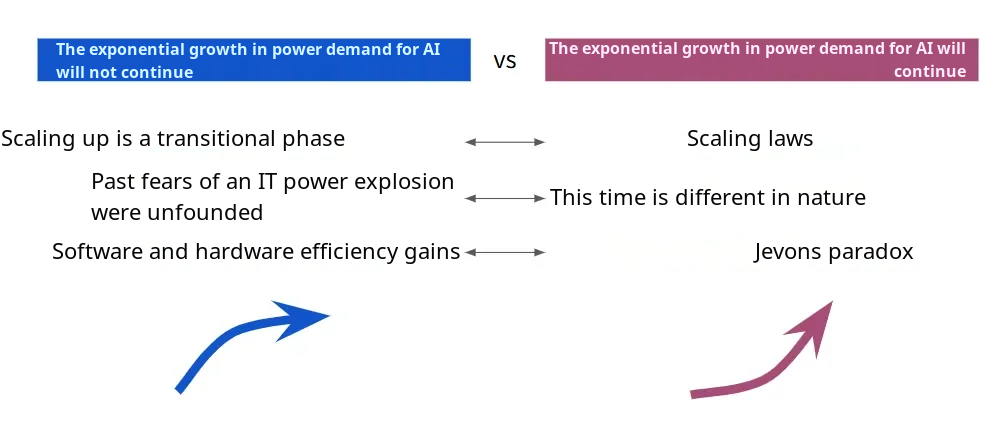 Source: Created by the author
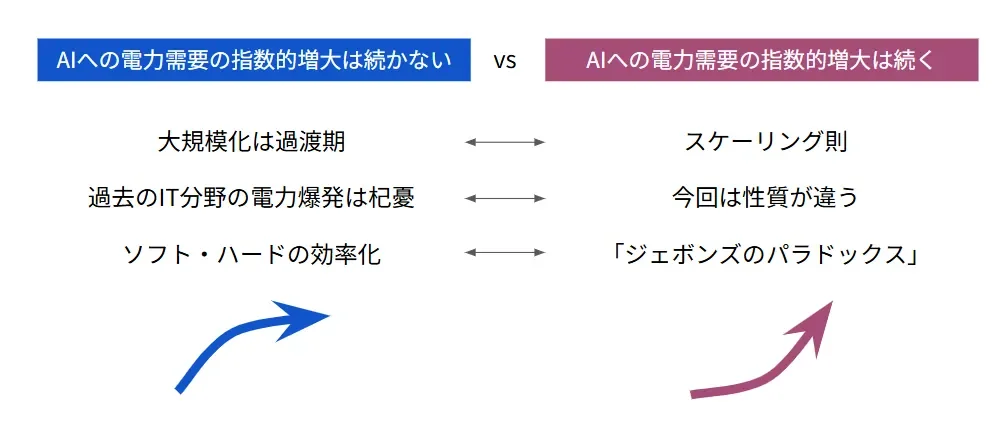
3. Risks Posed by the Surge in AI Power Demand
What risks are brought about by a sudden surge in AI power demand? Here is a brief overview.
- Power shortages in countries and regions: The concentration of data centers strains regional power supplies. Already, examples exist in places like Ireland and Singapore where permit systems have been introduced for new data center construction, or where mandatory adoption of renewable energy is being considered. There have also been reports of regional voltage quality deteriorating.
- Environmental footprints beyond electricity: Beyond power alone, building and operating AI data centers entails various environmental costs. Large-scale data centers require vast amounts of cooling water, posing a risk of exacerbating water shortages in water-scarce regions. The embodied footprint of data center construction itself (such as CO2 emitted during the manufacture of concrete, steel, and semiconductors) cannot be overlooked either. High-performance servers are said to last only 3–5 years, requiring frequent replacement. The capital expenditures required for such replacements also carry the risk of becoming sunk costs or liabilities in the future (example of a comprehensive analysis).
- Construction of additional power plants and lock-in to fossil fuels: When power demand for AI spikes and requires rapid expansion, clean energy sources like renewables and nuclear power cannot respond quickly enough on their own, ultimately necessitating the buildout of fossil fuel-based generation, such as coal- and gas-fired power plants. Once a fossil fuel plant is built, its operational lifespan spans decades, creating a substantial risk of locking in greenhouse gas emissions. This runs counter to the push toward carbon neutrality, and the trade-off between AI proliferation and environmental impact is expected to become increasingly pronounced.
If we enter an exponential growth scenario for AI power demand, addressing issues like those above will inevitably become an urgent priority.
5. Is Using AI “Bad for the Environment”?
Finally, a question that naturally arises from a user’s perspective is how significant the environmental footprint of using AI actually is. That said, at present, individual users rarely have opportunities to be directly mindful of the environmental cost of the AI they use. Even those conscious of energy conservation have limited means to know how much electricity cloud-based AI tools consume.
In recent years, a consensus has been forming that more energy is consumed by “inference” than by “training.” This is because once a large-scale model is trained, continuous, widespread daily use by a vast user base drives up total power consumption enormously. In a 2023 study, Luccioni et al. of Hugging Face compared the electricity consumption of open-source LLMs performing various tasks. As a result, they estimated that for several BLOOM models, for instance, 200 million to 600 million inferences equal the cost of training. Given that the ChatGPT website recorded 1.7 billion visits as of October 2023, estimates suggest that inference costs surpass training costs within a matter of weeks to months.
A frequently cited estimate claims that “power consumption for a single ChatGPT query during inference is 3 Wh, which is 10 times that of a Google search.” This originated in an October 2023 paper by Alex de Vries, founder of the startup Digiconomist. Subsequently, Epoch AI published an estimate showing that typical power consumption for GPT-4o is an order of magnitude lower, at around 0.3 Wh. Nevertheless, estimates vary depending on token length, and reasoning models that consume many tokens for chain-of-thought processing are believed to use considerably more electricity. There is also an estimate suggesting that when o3 tackled a difficult benchmark (ARC-AGI), it required an estimated 1,700+ Wh per question.
In any case, little information is accessible to everyday users, and only highly uncertain estimates exist regarding the environmental impact of AI usage. In February 2025, Hugging Face announced the “AI Energy Score” to compare the energy consumption of various AI models. This initiative tests submitted AI models under identical conditions, measuring and visualizing GPU energy consumption. While one hopes that such efforts will promote transparency, the situation is expected to remain opaque regarding frontier models from companies like OpenAI.
Brief Summary
The future of this issue is fraught with extreme uncertainty. Even if power demand from AI attempts to grow exponentially, it must hit limits in supply capacity somewhere; yet if that shift happens too abruptly, it could also inflict major negative impacts on human civilization. The question is likely at what pace and for how long this surge in demand will continue. Moreover, AI is also expected to exert positive effects on the environment. There are high hopes for AI applications that lead to energy conservation, as well as AI accelerating the development of nuclear fusion and quantum computing. The importance of such “efforts to offset the environmental footprint of AI through AI itself” will only increase.
The above represents a preliminary compilation based on publicly available information. While much remains unknown as of this writing, the IEA is scheduled to release a Special Report on Energy and AI in April 2025, and its contents may offer clearer visibility into the situation. Over the next few months, attention will likely focus on the extent to which other countries and companies follow the massive AI hardware investments led by the United States. It remains unpredictable whether competition among corporations and nations will create enough pressure to expand AI hardware that it forces major revisions to national energy policies.
Building on this preliminary survey, the AI Alignment Network plans to engage in discussions with external experts and disseminate information that serves domestic and international stakeholders.
Research and writing: Ryuichi Maruyama (Freelance Editor)
*This research was conducted under commission from the AI Alignment Network.
This article is reprinted from the ALIGN blog (February 18, 2025). It is posted on a test site to verify whether tomola can be used as ALIGN’s blog. Original article: https://www.aialign.net/blog/electricity
@maruyama