AI Safety Field Building in Japan
Author: Tomoki Kimura
Hello, I am Kimura, and I have recently taken on the role of Community Lead at ALIGN.
In this post, I write about my awareness of the issues at hand, why I decided to take on this role, and the kinds of activities I hope to pursue going forward.
Expectations and Risks of AI, and the Gap I Encountered
Over the course of roughly three years involved in AI R&D, I deepened my understanding of AI’s technical mechanisms and applications. As I experienced AI’s overwhelming potential firsthand, I also began thinking about the serious risks it poses, which led me to step into the field of AI Safety.
Later, while handling international affairs and liaising with overseas organizations at the Japan AI Safety Institute (AISI), I was able to catch a glimpse of the dynamics driving nations and governments. What struck me painfully then was the despairingly large gap between Japan and the rest of the world. Especially in a cutting-edge field like AI Safety, the divide in funding capabilities, technical expertise, and the sheer intensity of debate only continues to widen.
“Japan must also genuinely join this circle of global discussion.” Driven by this thought, I decided to join ALIGN as Community Lead in order to foster and invigorate AI Safety activities within Japan (Field Building).
AGI Risks and the Absence of Solutions
While the benefits of AI are immense, concerns are growing over its accompanying risks—especially the catastrophic risks posed by AGI (artificial general intelligence). For those unfamiliar with AGI risks, the report by Ryuichi Maruyama, who contributed greatly to ALIGN’s founding period, serves as an excellent reference, so please take a look.
Currently, many approaches to addressing AGI risks are emerging, such as the following:
- Mech Interp (Mechanistic Interpretability): Reverse-engineering and unraveling the internal workings of models
- Corrigibility: Designing AI so that it does not actively prevent its own shutdown or modification
- Alignment: Designing AI goals so that they are desirable
- Control: Utilizing AI while keeping risks within acceptable bounds, even when it cannot be aligned
- Scalable Oversight: How humans can evaluate and supervise AI systems that surpass human capabilities
- Symbiosis: An approach aiming for coexistence between AI and humans
However, none of these approaches guarantees success, and there is a possibility that all of them might fail. That is precisely why we need Field Building: cultivating the fertile ground to deepen existing ideas and continuously devise and validate entirely new approaches.
What Is “Field Building”?
Regarding Field Building, I refer to this report by The Bridgespan Group. A “field” refers to a collection of individuals and organizations sharing a common problem awareness.
This field is primarily composed of and characterized by the following five elements:
1. Knowledge Base Sources of information and toolsets to which everyone has shared access. Examples include AISI’s summary of security attacks against AI systems. It also includes English-language resources like BlueDot and LessWrong, as well as academic papers. While these are theoretically accessible to anyone, merely existing does not deliver practical benefits due to language barriers and high technical complexity. Not everyone needs to understand everything; what matters is having a mechanism where members within the community who do understand can share that knowledge as needed, giving back to the community as a whole. Furthermore, benchmarks like METR and toolsets such as AISI’s model evaluation tools, which have been open-sourced so non-engineers can use them, also serve as vital pieces supporting this foundation.
2. Actors Individuals and organizations sharing a common identity and problem awareness. This includes directly recognizable contributors like researchers, engineers, and policymakers, as well as those supporting and managing operations—encompassing everyone involved across diverse roles.
3. Field-level agenda The commonly assumed problem awareness and the approaches taken toward it. Broadly speaking, it is “how to address the risks surrounding AI,” but the approaches are granular, corresponding to hierarchical technical challenges like the aforementioned Mech Interp, Corrigibility, and Scalable Oversight.
4. Resources The foundational assets that underpin activities. In terms of financial support, funders like Coefficient Giving are prime examples, enabling many AI Safety activities. Beyond funding, educational programs like BlueDot Impact are also essential elements for cultivating talent as a resource.
5. Infrastructure The foundation that connects the above four elements and generates synergies. For example, LISA in the UK runs a coworking space for the AI Safety field, functioning as an incubator that provides space and guidance for startups, as well as a venue for hosting events. Although its standalone impact is difficult to measure, it is an extremely effective element for vitalizing the field as a whole.
Field Building in Japan, Too!
As you can see from this map, a robust field is already taking shape in the English-speaking world. I constantly keep up with the latest updates from abroad, but I often feel frustrated by how technical discussions in Japan seem somewhat out of sync with global trends and fail to integrate them well.
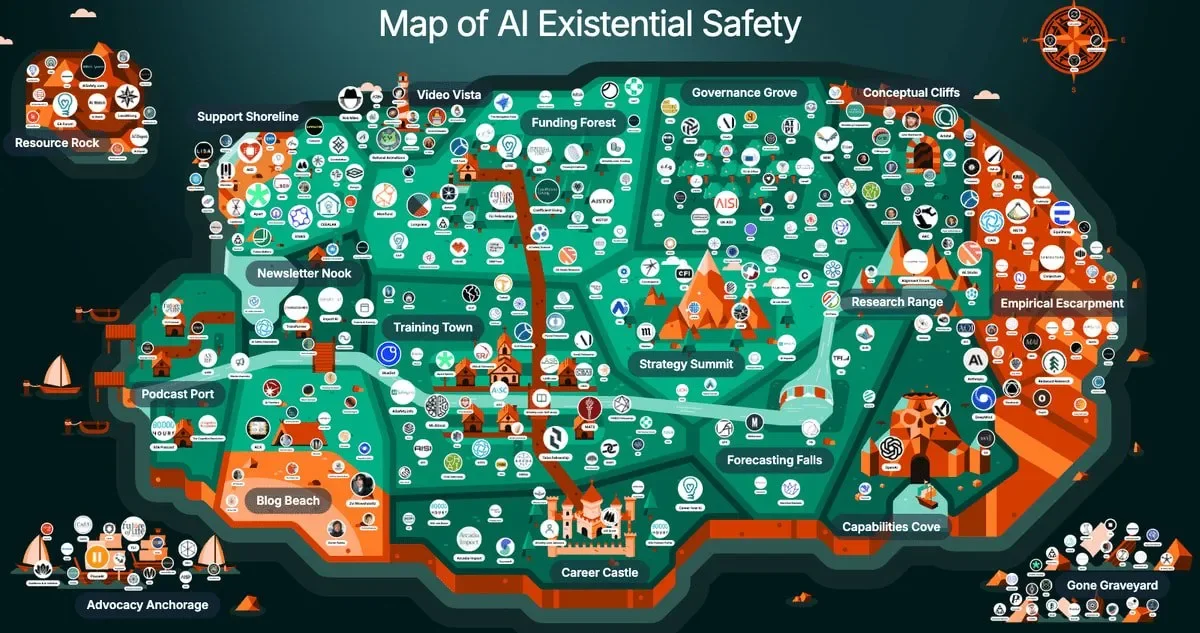
First, absorbing the achievements of global Field Building into Japan and falling into step; ultimately, having a community originating from Japan become a vital piece of the global ecosystem. That is what I am aiming for.
What We Will Do Going Forward
Such broad-scale Field Building does not happen spontaneously, so we must pursue it deliberately. As for what we will specifically do, as a general guide, we will work while keeping each of the five elements mentioned above in mind.
For instance, to build a Knowledge Base for the field, we could hold study sessions to investigate and share cutting-edge research. While ALIGN has engaged in these in the past, we can build a mechanism to conduct them sustainably.
Though not yet widely known, such initiatives are already taking place on a small scale. AI Safety Tokyo regularly hosts study sessions that anyone interested is welcome to join. TARA is a bootcamp for aspiring AI Safety researchers and engineers, offering hands-on learning from fundamental AI theory to advanced topics, and has been running since March 2026.
Additionally, preparing a shared space like LISA mentioned above promises to have a significant impact. Achieving this requires securing funding and finding personnel capable of running it, neither of which we currently possess. Keeping these in mind, reaching out to funders like Coefficient Giving for support will be one of our activities.
Please Join Our Activities!
AI Safety is a field that does not yet have established answers, yet it is critically important for everyone. If you have even the slightest interest in this field or our activities, we would be delighted to have you get involved, such as by participating in our study sessions.
I look forward to working with you all!
This article is a reprint from the ALIGN blog (March 17, 2026). It has been posted on a test site to verify whether tomola can be used as a blog for ALIGN. Original text: https://www.aialign.net/blog/ai-safety-field-building-in-japan
ALIGN