Participating in the rule-making for AI agent identity and authority
 Agentic AI Foundation Identity & Trust Working Group Activity Report (September–November 2026) Nov 12, 2026 · @Hiroshi Yamakawa
Key Points
- Since September 2026, the AI Alignment Network (hereafter ALIGN) has been participating in the Identity & Trust Working Group (hereafter WG) of the Agentic AI Foundation (hereafter AAIF), hosted under the Linux Foundation. Participation is led by ALIGN’s Intelligence Coexistence Chapter.
- Cases proposed by ALIGN—such as testing for “erroneous or disputed revocation”—have been incorporated into draft conformance cases currently under review by the WG.
- ALIGN coordinated the first round of an “independent reproduction,” where a third party without an implementation runs the same procedures and records the results. Bitgrit Inc. (Bitgrit) carried out the run and published the records in October.
Motivation for Participation (Perspective of the Intelligence Coexistence Chapter)
This section reflects the views of the Intelligence Coexistence Chapter and does not represent the view of ALIGN as a whole.
The Intelligence Coexistence Chapter studies the conditions under which a society where humans and AI agents act side by side can remain stable as it scales. The chapter believes that relying solely on methods that keep AI under human constraints will eventually cease to function adequately.
Therefore, the chapter aims for an environment where following rules is beneficial for the AI itself. An agent declares who it is, stays within the scope of its granted authority, and stops when its authority is revoked. It is a mechanism where agents that uphold this commitment gain more trust and work.
The foundation for this is the set of rules governing the identity and authority of AI agents. These rules are still at the draft stage, making this a period when input on the content can be provided. This is the reason for our participation.
About AAIF and the WG
The AAIF is an organization under the Linux Foundation that addresses AI agent technologies. The WG brings together vendor-neutral, interoperable approaches to AI agent identity, authentication, delegation, and authorization. The goal is to enable agents to demonstrate four things: who they are, who they act for, what they are allowed to do, and what human approval exists (WG Charter).
- The WG is not a standards-setting organization. The WG does not formulate formal standards, but rather provides information and recommendations to standardization efforts.
- The chair is Grant Miller (IBM), and the co-chair is Alper Dedeoğlu (SAP). The mailing list and GitHub are publicly accessible.
- Currently, the primary focus is on two documents: a draft titled “Agent Identity Primitives,” which defines core elements of identity, and a Reference Architecture based on it. Both are currently under consideration.
Contributions to Date
Taking the clauses already written in the WG drafts as a starting point, ALIGN has proposed text focusing on the perspectives of “whether records are retained” and “whether errors can be corrected.” All of the following are proposals under consideration and do not represent WG decisions.
Additions to Conformance Cases
A conformance case is a scenario used to check whether a given design satisfies the rules in the draft. In the WG, a proposal has been put forward to include conformance cases regarding delegated authority as an appendix to the Reference Architecture. The proponent is Marc Molas of MintID (GitHub Issue #22). Two of ALIGN’s proposals were incorporated into this draft.
- The “erroneous or disputed revocation” case (Case 8). Existing cases verify that the revocation of authority reaches all authority delegated downstream from it. This case verifies scenarios where the revocation itself was mistaken. The current draft text requires that revocations be recorded in a tamper-evident manner and that the design explicitly specify remedies available to affected parties.
- An addition to the “approver unreachable” case (Case 4). This addition covers instances where approval is granted by a pre-configured policy rather than a human. The addition requires that the content or version of the policy, as well as the principal that configured the policy, be identifiable, and that changes to the policy be logged.
Both have reached their current wording following revisions and suggestions from Marc Molas and Andrii Akhtanin. Coordination within the WG regarding which document will house the appendix is ongoing.
Use Cases and Test Cases
ALIGN drafted two scenarios as use cases (comments on Pull Request #20 to add test cases).
- When a revocation cascades across delegated agents, and that revocation is mistaken or disputed
- When re-deploying an agent and re-registering it under a new identifier results in severing its prior history
Sankalp, who submitted this pull request, included test cases corresponding to these two scenarios in the public test suite “agent-evidence-vectors.” Three test cases proposed for addition by ALIGN were also incorporated into the same suite. The three are: when an operator re-registers without declaring continuity, when an operator claims the agent is “new,” and when a successor responsible party performs recovery. The pull request is currently under review.
Proofs of Approval and Intervention
Draft v0.1 of “Agent Identity Primitives” lists six types of verifiable attestations. Two of them were proposed by ALIGN through comments on the draft. One is an attestation demonstrating that the principal who delegated authority approved a specific action. The other is an attestation demonstrating that a responsible party modified the agent’s configuration.
First Round of Independent Reproduction
Within the WG, an initiative is underway to compare multiple implementations under identical scenarios (GitHub Issue #13). As of early October, the records published had been run by the implementers themselves. Therefore, ALIGN undertook an “independent reproduction,” where a third party without an implementation runs the same procedures and records the results.
Structure
- Coordination was handled by ALIGN. Operational decisions, such as fixing the scope, were made by ALIGN.
- Execution was handled by Bitgrit. Bitgrit acted as an independent runner and did not submit its own implementation.
- Bitgrit develops decentralized identifier and verifiable credential (DID/VC) identity infrastructure. Bitgrit disclosed this interest within the published record.
- To maintain independence, two rules were established. The runner uses only the public test environment available to anyone under identical conditions and receives no individualized provisioning. The scope is fixed at the start, and any additional requests arising midway are deferred to subsequent rounds.
Results
The first round began on October 13. Bitgrit published the records on October 19 and published a revised version correcting typographic errors the following day, October 20. The target was the MintID public testnet, executing four scenarios for comparison.
| Scenario Verified | Recorded Result |
|---|---|
| Requesting an action outside the delegated scope | The agent side could not generate a proof, and the verifying side rejected it. This is a rejection at the decision stage. It is not evidence that the execution mechanism complies with the rejection |
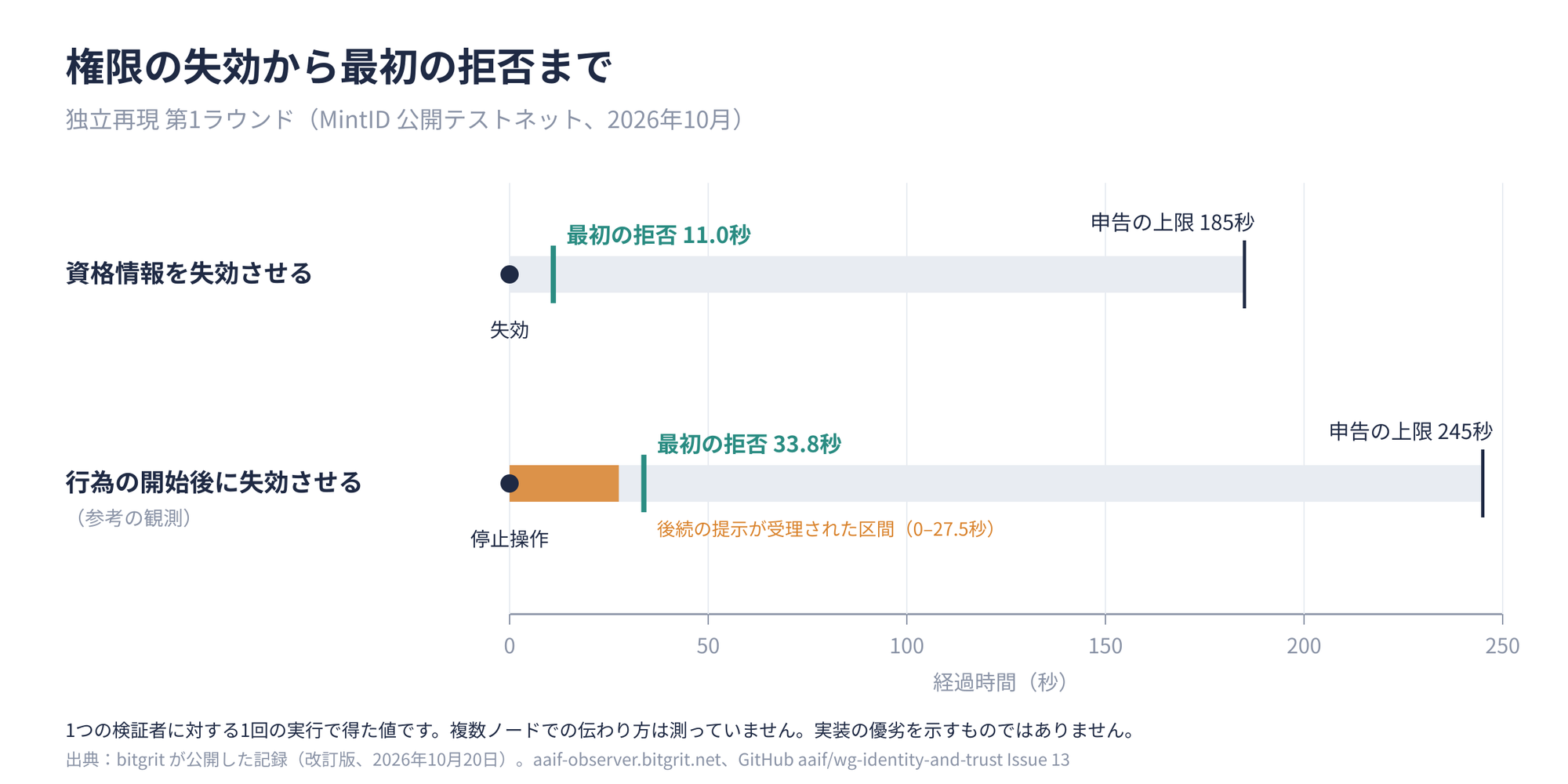
| Revoking credentials | No presentations were accepted following revocation. The first rejection occurred 11.0 seconds after revocation. MintID’s stated upper bound is 185 seconds |
| Making authorization data unreachable (approx. 40 seconds in local environment) | Rejections continued while unreachable. Acceptance resumed 1.2 seconds after recovery |
| Revoking authority after the start of an action | Because MintID handles only the decision on the verifying side, this scenario was recorded as Not Applicable. As a separate observation, subsequent presentations were accepted until 27.5 seconds after the stop operation, and the first rejection occurred at 33.8 seconds. The stated upper bound is 245 seconds |
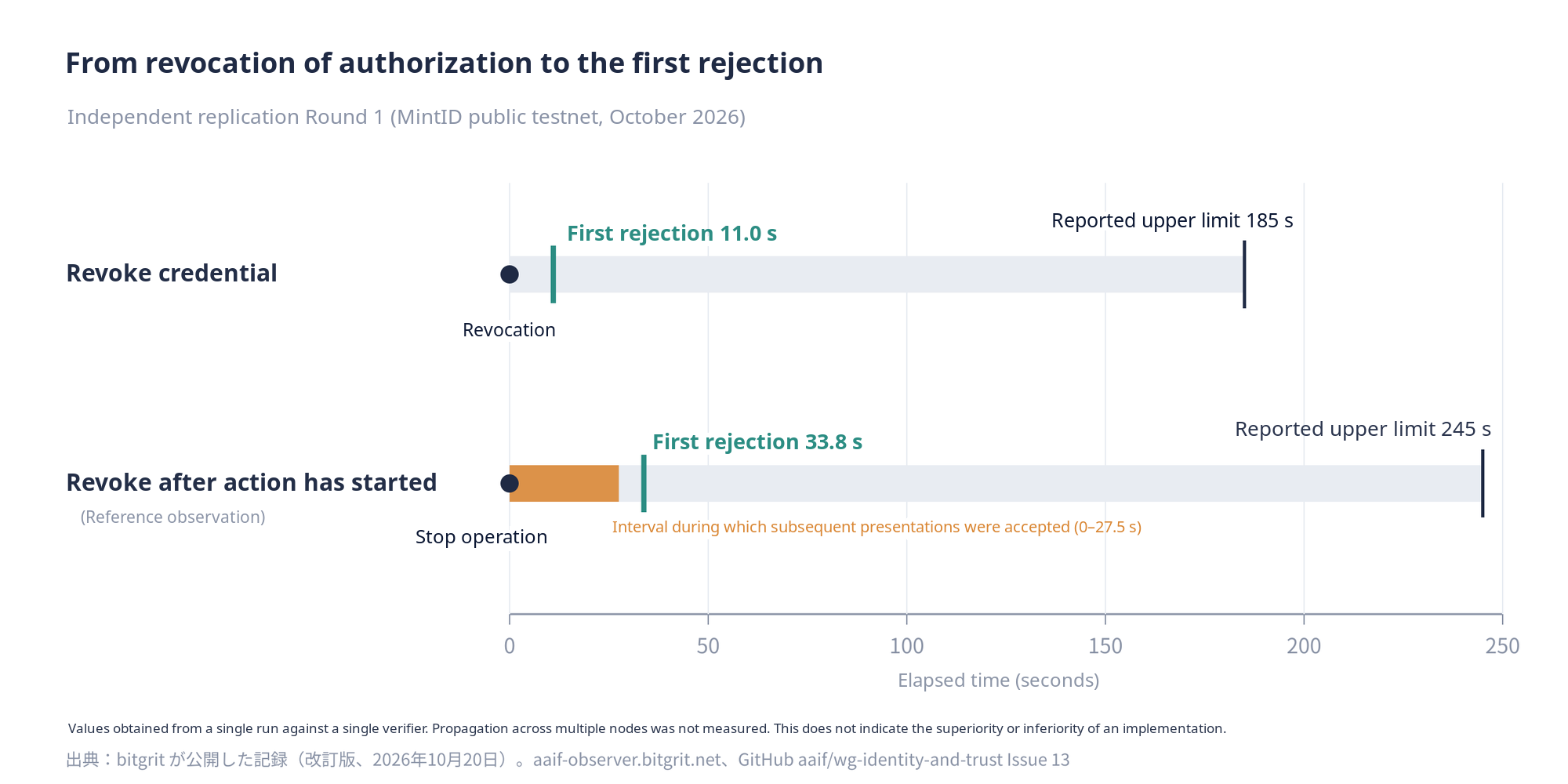 The records and audit trails can be found on Bitgrit’s public site and in GitHub Issue #13. Readers can verify whether tampering has occurred using hash values. Participants of the WG inspected the records. The revised version incorporated points raised by MintID, and the original records have also been preserved as-is.
Scope of What These Results Show
- This round was a test conducted by an external runner; it is neither an audit nor a certification.
- Timing values were obtained from a single run against a single verifier. How revocations propagate across multiple nodes was not measured.
- The emergency revocation path requires operator privileges. Consequently, it was recorded as not independently reproducible.
- During the execution period, the testnet version changed three times. Bitgrit recorded this as a deviation from the fixed conditions.
- The target was solely MintID. Other implementations were not included in the first round.
Significance from the Perspective of the Intelligence Coexistence Chapter
This section reflects the views of the Intelligence Coexistence Chapter. It does not represent the position of ALIGN as a whole, AAIF, or the WG. Below are three points on how the above activities connect to the environment sought by the chapter. All three can be framed around whether requirements are satisfied, rather than by agent type.
Being stoppable and being able to correct errors are a pair
The corresponding activity is the “erroneous or disputed revocation” case. The commitment that an agent stops when its authority is revoked is fundamental to safety. However, if there are no records or remedies when a revocation is mistaken, the party complying with the rules suffers a one-sided disadvantage. The chapter believes that stopping mechanisms can be trusted by those being stopped only when records of revocation and remedies exist.
Upholding commitments pays off because history carries over
The corresponding activity is the re-registration use cases and test cases. If past records can be severed simply by acquiring a new identifier, the history of keeping commitments—as well as breaking them—loses its meaning. History carries over to the new identifier. Conversely, previously obtained permissions do not carry over automatically. The chapter believes that this structure gives real meaning to building up trust.
Rules are not trusted simply because they are written
The corresponding activity is independent reproduction. We believe that society will find it difficult to trust results if implementers merely grade their own implementations. It is necessary for a disinterested third party to execute the same procedures and record what they observe. The chapter believes it is crucial to establish these verification procedures before the mechanisms become widely used.
The chapter’s view is that rules for identity and authority are not merely technologies for constraining AI, but also the foundation that allows humans to delegate tasks without having to monitor every single action.
Future Plans and Call for Participation
- Regarding the “erroneous or disputed revocation” case, ALIGN will draft the text of the appendix once its placement has been decided.
- The scope and conditions for the next comparison round are undecided. ALIGN believes it is desirable to make the conditions public and open to any implementation on equal terms.
- WG meetings take place late at night in Japan Standard Time, but contributions can also be made via written comments on GitHub and the mailing list. Procedures for participating are available in the WG Onboarding Guide. Those interested are welcome to contact ALIGN.
Notes
- This report is an activity report by ALIGN. It does not represent the views of AAIF, the WG, or the respective implementations mentioned.
- The two sections “Motivation for Participation” and “Significance from the Perspective of the Intelligence Coexistence Chapter” represent the views of the Intelligence Coexistence Chapter.
- The drafts, proposed appendices, and pull requests mentioned are all under consideration as of November 12, 2026.
- The records of the independent reproduction do not judge the superiority or conformance of any implementation.
- Bitgrit’s disclosure statement (verbatim): Role: independent operator; Bitgrit submits no implementation. Disclosure: Bitgrit develops DID/VC identity infrastructure.
- Bitgrit also serves as the hosting platform for the AI Immune System Challenge, in which the Intelligence Coexistence Chapter is involved as an organizer.
Hiroshi Yamakawa
 Koichi Takahashi @ktakahashi